
Higher November 2017 Unit 1 Q19
19.
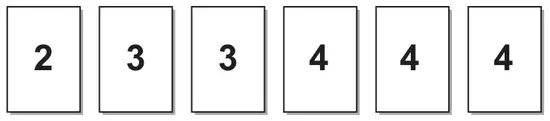
Two of the cards shown above are selected at random, without being replaced.
Find the probability that
(a) the product of the two numbers selected is 12, [3]
(b) the sum of the two numbers selected is even. [4]
| Scheme | Marks | Comments |
|---|---|---|
| 2/6 × 3/5 + 3/6 × 2/5 OR 2 × 2/6 × 3/5 OR 2 × 3/6 × 2/5 | M2 | P(3, 4 or 4, 3). M1 for sight of 2/6 × 3/5 or sight of 3/6 × 2/5. |
| 12/30 (= 2/5) | A1 | CAO. Mark final answer If no marks gained, award SC1 for method ‘with replacement’ leading to 12/36 (= 1/3) |
Alternative method
| Scheme | Marks | Comments |
|---|---|---|
| A list of the 30 possible ordered pairs (permutations) with the correct 12 identified OR a list of the 15 possible pairs (combinations) with the correct 6 identified OR a 6 × 6 two-way table with diagonal deleted to leave 30 spaces with the correct 12 identified | M2 | (otherwise M1 for a sample space of 30, or M1 for identifying the correct 6 combinations or the correct 12 ordered pairs (permutations)) |
| 12/30 (= 6/15 = 2/5) | A1 | CAO |
| Scheme | Marks | Comments |
|---|---|---|
| F.T. consistent use of incorrect total number of cards. | ||
| Strategy of finding P(even, even) and P(odd, odd) | S1 | Or equivalent e.g. P(2,4) + P(4,2) + P(3,3) + P(4,4) or e.g. 1 – P(sum is odd) |
| 4/6 × 3/5 + 2/6 × 1/5 | M2 | OR M2 for 1/6 × 3/5 + 3/6 × 1/5 + 2/6 × 1/5 + 3/6 × 2/5 OR M2 for 1 – (4/6 × 2/5 + 2/6 × 4/5) M1 for sight of 4/6 × 3/5 or sight of 2/6 × 1/5 OR M1 for sight of two of the following products 1/6 × 3/5, 3/6 × 1/5, 2/6 × 1/5, 3/6 × 2/5 OR M1 for sight of 4/6 × 2/5 or sight of 2/6 × 4/5 |
| 14/30 (= 7/15) | A1 | CAO. Mark final answer. If no marks gained, award S1 SC1 for method ‘with replacement’ leading to 20/36 (= 5/9) |
Alternative method
| Scheme | Marks | Comments |
|---|---|---|
| Strategy of finding P(even, even) and P(odd, odd) or equivalent e.g. P(2,4) + P(4,2) + P(3,3) + P(4,4) or e.g. 1 – P(sum is odd) | S1 | (If a strategy is not explicitly stated, S1 may be awarded retrospectively for sight of a correct probability) |
| A list of the 30 possible ordered pairs (permutations) with the correct 14 identified OR a list of the 15 possible pairs (combinations) with the correct 7 identified e.g. as (2, 4), (2, 4), (2, 4), (3, 3), (4, 4), (4, 4), (4, 4) OR a 6 × 6 two-way table with diagonal deleted to leave 30 spaces with the correct 14 identified | M2 | (otherwise M1 for a sample space of 30, or M1 for identifying the correct 7 combinations or the correct 14 ordered pairs (permutations)) |
| 14/30 (= 7/15) | A1 | CAO |