
June 2019 Unit 4 Q9
9. The diagram below shows a spotlight system that consists of a symmetrical track \(XY\) that is suspended horizontally from the ceiling by means of two vertical wires.
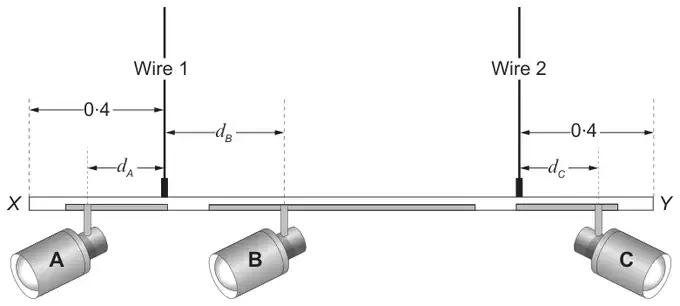
Each of the three spotlights \(A\), \(B\), \(C\) may be moved horizontally along its corresponding shaded section of the track. The system remains in equilibrium.
The track may be modelled as a light uniform rod of length 1·8 m and the wires are fixed at a distance of 0·4 m from each end. Each of the spotlights may be modelled as a particle of mass \(m\) kg, positioned at the points where they are in contact with the track.
The distances of the spotlights relative to the wires are given in the diagram and are such that
\[0\leqslant d_{A}\leqslant 0{\cdot}3,\qquad\quad 0{\cdot}1\leqslant d_{B}\leqslant 0{\cdot}9,\qquad\quad 0\leqslant d_{C}\leqslant 0{\cdot}3.\](a) Given that \(T_1\) and \(T_2\) represent the tension in wires 1 and 2 respectively, show that \[T_1=mg(2+d_{A}-d_{B}-d_{C}),\] and find a similar expression for \(T_2\). [6]
(b)
(i) Find the maximum possible value of \(T_1\).
(ii) Without carrying out any further calculations, write down the maximum possible value of \(T_2\). Give a reason for your answer. [3]
| Scheme | Marks | Comments |
|---|---|---|
| Moments about base of wire 2 | M1 | Dim. correct, all forces/terms |
| \(mgd_C+T_1\times 1=mg(1+d_A)+mg(1-d_B)\) | A1 | cao |
| \(T_1=mg+mgd_A+mg-mgd_B-mgd_C\) | ||
| \(T_1=mg(2+d_A-d_B-d_C)\) | A1 | Convincing |
| Resolve vertically \(T_1+T_2=3mg\) | M1 A1 | Dim. correct, all forces/terms |
| \(T_2\ =3mg-T_1\) | ||
| \(T_2=mg(1-d_A+d_B+d_C)\qquad\text{oe}\) | A1 | cao |
| [6] |
| Scheme | Marks | Comments |
|---|---|---|
| (i) For maximum tension in \(T_1\) \(d_A=0{\cdot}3\) (maximum) \(d_B=0{\cdot}1\) (minimum) \(d_C=0\) (minimum) \(T_1=mg(2+0{\cdot}3-0{\cdot}1-0)\) | M1 | Used with at least 2 out of 3 correct |
| Maximum \(T_1=2{\cdot}2mg\) | A1 | cao |
| (ii) Maximum \(T_2=2{\cdot}2mg\), due to symmetry | B1 | FT candidate’s value of \(T_1\). Reason MUST be given |
| [3] | ||
Total for Question 9 | 9 |