
June 2019 Unit 4 Q7
7. Three coplanar horizontal forces of magnitude 21 N, 11 N and 8 N act on a particle \(P\) in the directions shown in the diagram.
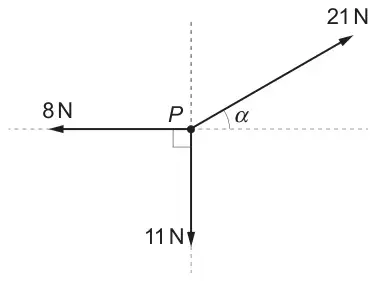
(a) Given that \(\tan\alpha=\dfrac{3}{4}\), calculate the magnitude of the resultant force. [5]
(b) Explain why the forces cannot be in equilibrium whatever the value of \(\alpha\). [1]
| Scheme | Marks | Comments |
|---|---|---|
| Attempt to resolve in two directions | M1 | No missing/extra forces, |
| \(X=\pm 21\cos\alpha\mp 8\) \(\quad=\pm 21\times 0{\cdot}8\mp 8\) \(\quad=\pm 8{\cdot}8\) | A1 | \(21\cos\alpha\) and \(8\) opposing |
| \(Y=\pm 21\sin\alpha\mp 11\) \(\quad=\pm 21\times 0{\cdot}6\mp 11\) \(\quad=\pm 1{\cdot}6\) | A1 | \(21\sin\alpha\) and \(11\) opposing |
| \(R=\sqrt{(\pm 1{\cdot}6)^2+(\pm 8{\cdot}8)^2}\) \(\quad=4\sqrt{5}\ \ \text{or}\ \ 8{\cdot}9(4427\ldots)\ \ (\mathrm{N})\) | m1 A1 | FT \(X,Y\) provided dim. correct cao |
| [5] |
| Scheme | Marks | Comments |
|---|---|---|
For any valid reason with correct working, e.g.
| E1 | |
| [1] | ||
Total for Question 7 | 6 |