
June 2019 Unit 4 Q3
3. At a fairground, Kirsty throws \(n\) balls in order to try to knock coconuts off their stands. Any coconuts she knocks off are replaced before she throws again. Kirsty counts the number of coconuts she successfully knocks off their stands. On average, she knocks off a coconut with 20% of her throws.
(a) What assumptions are needed in order to model this situation with a binomial distribution? Explain whether these assumptions are reasonable. [2]
Kirsty uses a spreadsheet to produce the following diagrams, showing the probability distributions of the number of coconuts knocked off their stands for different values of \(n\).
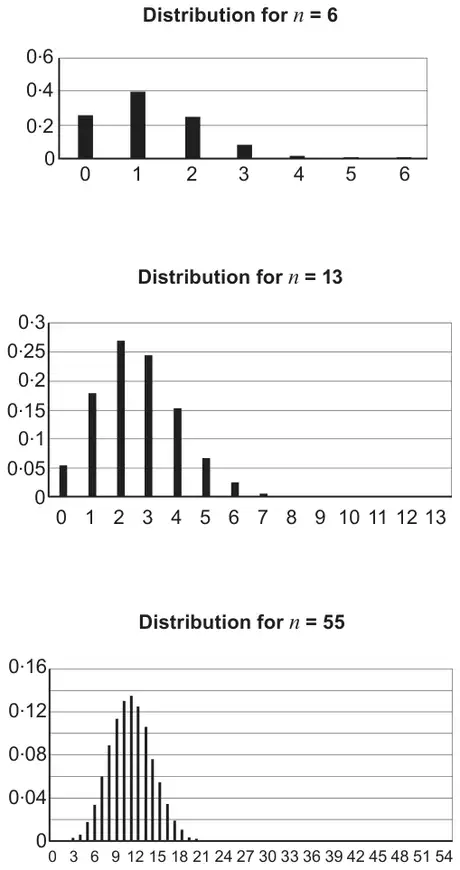
(b) Describe two ways in which the distribution changes as \(n\) increases. [2]
| Scheme | Marks | Comments |
|---|---|---|
| Each throw is independent AND The probability 0.2 stays the same for each throw. | B1 | Ignore reference to statements based on fixed \(n\) and success/failure outcomes. |
| Valid reason. Eg. No because she may improve with practice. No, because she may get frustrated and the probability 0.2 might decrease. Yes. She is unable to improve her performance. | B1 |
| Scheme | Marks | Comments |
|---|---|---|
| Two valid changes. As \(n\) increases: e.g. the distribution becomes more symmetrical e.g. more bell-shaped e.g mean increases e.g. variance/SD increases e.g. mode increases e.g. probability of mode decreases e.g. the probability of knocking at least one coconut off increases. | B1 B1 | |
| [4] |