
June 2025 Unit 3 Q6
6. The diagram below shows a sketch of the curve with equation \(y=\mathrm{e}^x\) and the straight line with equation \(y=3x\).
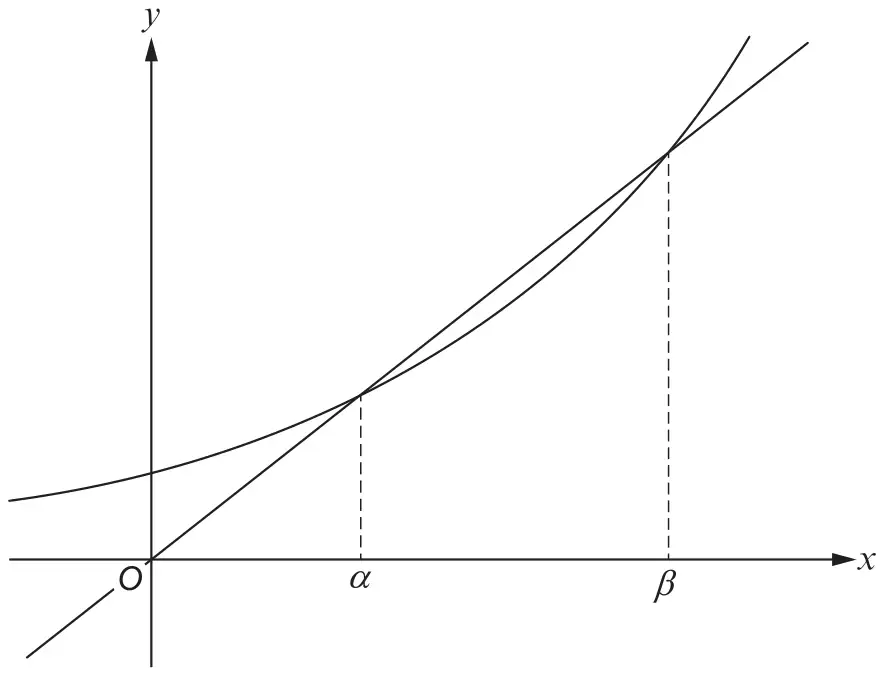
The straight line intersects the curve at the points where \(x=\alpha\) and \(x=\beta\). Approximate values for \(\alpha\) and \(\beta\) are \(0{\cdot}62\) and \(1{\cdot}5\) respectively.
(a) The iterative formula \(x_{n+1}=\dfrac{1}{3}\mathrm{e}^{x_n}\) is used to find a more accurate approximation for \(\alpha\). Taking \(x_0=0{\cdot}62\), use the iterative formula to obtain the values of \(x_1\), \(x_2\) and \(x_3\). Give your answers correct to three decimal places. [2]
(b) The Newton-Raphson method is used to find a more accurate approximation for \(\beta\).
(i) Taking \(f(x)=\mathrm{e}^x-3x\) and starting with \(x_0=1{\cdot}5\), apply the Newton-Raphson method once to obtain a second approximation, \(x_1\). Give your answer correct to three decimal places. [3]
(ii) Show that \(x_1\) is the value of \(\beta\) correct to three decimal places. [2]
(iii) Explain why the Newton-Raphson method fails if the starting value in the approximation of \(\beta\) is \(\ln 3\). [1]
| Scheme | Marks | Comments |
|---|---|---|
| \(x_{n+1}=\frac{1}{3}\mathrm{e}^{x_n}\) \(x_0=0.62\) | ||
| \(x_1=(0.61964268061=)\,0.620\) | B1 | B0 for 0.62 |
| \(x_2=(0.61942130982=)\,0.619\) \(x_3=(0.61928420321=)\,0.619\) | B1 | \(x_2,\ x_3\) correct, Mark final answers If answers more than 3dp, allow B1 for all correct. |
| [2] |
| Scheme | Marks | Comments |
|---|---|---|
| (i) \(f(x)=\mathrm{e}^x-3x,\) | ||
| \(f'(x)=\mathrm{e}^x-3\) | B1 | si |
| \(x_{n+1}=x_n-\dfrac{\mathrm{e}^{x_n}-3x_n}{\mathrm{e}^{x_n}-3}\) | M1 | seen or used, FT their \(f'(x)\) |
| \(x_0=1.5\) | ||
| \(x_1\ (=1.512(358146))=1.512\) | A1 | cao |
| (ii) Consider \(f(x)=\mathrm{e}^x-3x\) | ||
| \(f(1.5115)=\mathrm{e}^{1.5115}-3\times 1.5115=-0.00097\lt 0\) | M1 | ft their \(x_1\) for M1 only |
| \(f(1.5125)=\mathrm{e}^{1.5125}-3\times 1.5125=0.00056\gt 0\) | (M1) | if not awarded previously |
| Sign change (and continuity of \(f(x)\)) shows 1.512 is a root to 3 dp | A1 | |
| (iii) If \(x=\ln 3\), denominator \(f'(\ln 3)=\mathrm{e}^{\ln 3}-3=3-3=0\) | ||
| Hence the Newton-Raphson process will fail. | E1 | convincing |
| [6] |