
Maclaurin 2019 Q6
6. A tiling of an \(n \times n\) square grid is formed using \(4 \times 1\) tiles.
What are the possible values of \(n\)?
Maclaurin Olympiad 2019, Question 6. © UK Mathematics Trust. Original paper on ukmt.org.uk
Answer: The multiples of 4 (only)
Each tile is of area 4, so the area of the grid is a multiple of 4. Hence \(n\) is even. We consider two cases, determined by whether \(n\) is a multiple of 4 or not.
\(\boldsymbol{n = 4k}\), for some positive integer \(\boldsymbol{k}\)
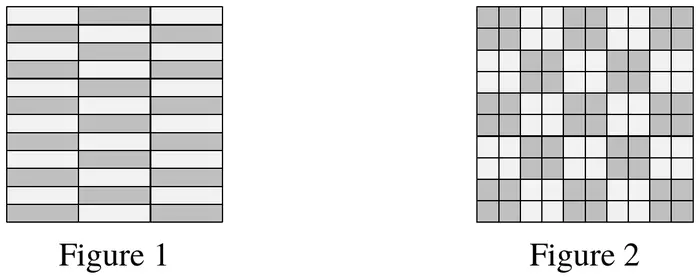
In this case the grid can be tiled using \(4k^2\) tiles, with each row containing \(k\) tiles. Figure 1 shows the case \(k = 3\).
\(\boldsymbol{n = 4k - 2}\), for some positive integer \(\boldsymbol{k}\)
In this case the grid cannot be tiled. To see this, colour the grid in a \(2 \times 2\) chessboard pattern, as shown in Figure 2, where \(k = 3\).
Notice that, in whatever way a \(4 \times 1\) tile is placed on the coloured grid, it will cover two cells of each colour. So if it were possible to tile the grid using \(4 \times 1\) tiles, then they would cover an equal number of \(1 \times 1\) squares of each colour.
However, there is an odd number of \(2 \times 2\) squares in the grid, so that the number of \(1 \times 1\) squares of one colour in the coloured grid is always four more than the number of \(1 \times 1\) squares of the other colour.
Hence such a tiling is impossible.
Therefore the values of \(n\) for which it is possible to tile an \(n \times n\) grid with \(4 \times 1\) tiles are the multiples of 4 (only).
Solution © UK Mathematics Trust, from the Maclaurin Olympiad 2019 solutions.