
Maclaurin 2015 Q4
4. The diagram shows two circles with radii \(a\) and \(b\) and two common tangents \(AB\) and \(PQ\). The length of \(PQ\) is 14 and the length of \(AB\) is 16.
Prove that \(ab = 15\).
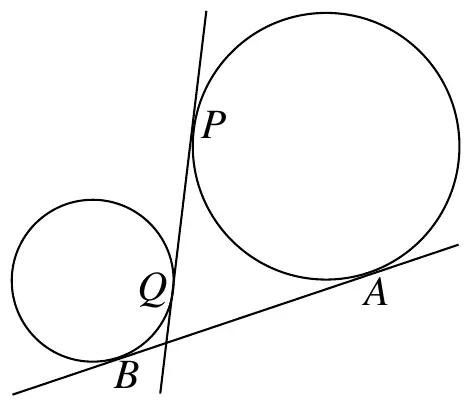
Maclaurin Olympiad 2015, Question 4. © UK Mathematics Trust. Original paper on ukmt.org.uk
Let the centres of the circles be \(C\) and \(D\).
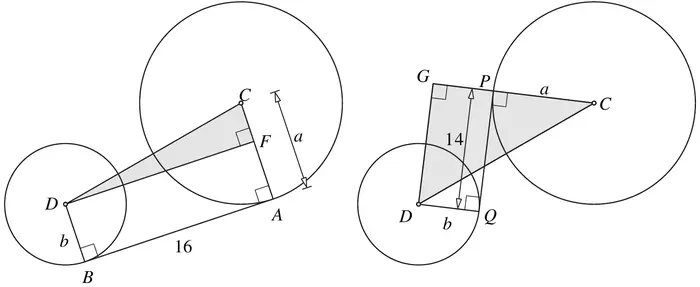
Firstly, consider the tangent \(AB\) (see the left-hand figure above). Join \(C\) to \(A\) and \(D\) to \(B\), forming two right angles, as shown, since tangent and radius are perpendicular. Let \(F\) be the foot of the perpendicular from \(D\) to \(CA\). Then \(AFDB\) is a rectangle, so that \(AF = b\) and \(FD = 16\).
From Pythagoras' Theorem for right-angled triangle \(CDF\), we therefore obtain
Next, consider the tangent \(PQ\) (see the right-hand figure above). Join \(C\) to \(P\) and \(D\) to \(Q\), once again forming two right angles, as shown, since tangent and radius are perpendicular. Let \(G\) be the foot of the perpendicular from \(D\) to \(CP\). Then \(PGDQ\) is a rectangle, so that \(PG = b\) and \(GD = 14\).
From Pythagoras' Theorem for right-angled triangle \(DCG\), we therefore obtain
It follows from equations (2) and (1) that
and hence
In order to simplify this equation we could just multiply out the brackets, but it is a little quicker to use the ‘difference of two squares’ factorisation \(x^2 - y^2 = (x - y)\,(x + y)\) for each side, which also avoids any squaring! On doing this, we get
and hence
Now in the diagrams we assigned each of \(a\) and \(b\) to be the radius of a particular circle, whereas the question does not do so. However, interchanging \(a\) and \(b\) in the result leaves it unchanged, which means that the result is independent of the assignment of letters.
Solution © UK Mathematics Trust, from the Maclaurin Olympiad 2015 solutions.