
Hamilton 2017 Q3
3. The diagram shows squares \(ABCD\) and \(EFGD\). The length of \(BF\) is 10 cm. The area of trapezium \(BCGF\) is 35 cm2.
What is the length of \(AB\)?
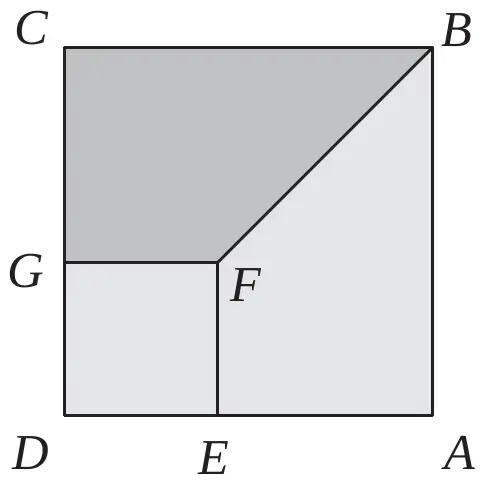
Hamilton Olympiad 2017, Question 3. © UK Mathematics Trust. Original paper on ukmt.org.uk
Answer: \(6\sqrt{2}\) cm
The point \(F\) lies on the diagonal \(BD\) of the square \(ABCD\), so that \(\angle FBC\) is equal to 45°. Let point \(X\) lie on \(BC\) so that \(\angle FXB = 90^\circ\), as shown in the diagram alongside. Then \(\angle XFB = 45^\circ\) from the angle sum of triangle \(BXF\); it follows from ‘sides opposite equal angles are equal’ that \(BX = XF\).
Now, using Pythagoras' Theorem in triangle \(BXF\), we obtain \(XF = 5\sqrt{2}\) cm. But \(CGFX\) is a rectangle, so that \(CG = XF\).
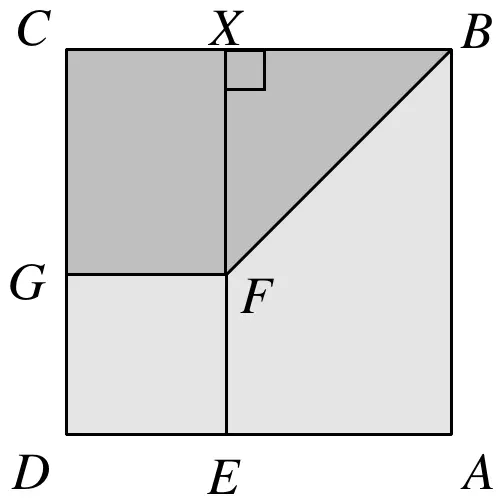
Let the length of \(AB\) be \(a\) cm. Then
\(\tfrac{1}{2} \times 5\sqrt{2} \times \left(2a - 5\sqrt{2}\right) = 35\) and so \(2a - 5\sqrt{2} = \dfrac{14}{\sqrt{2}}\).
Hence \(2a = 5\sqrt{2} + 14\dfrac{\sqrt{2}}{2}\), so that \(a = 6\sqrt{2}\).
Therefore the length of \(AB\) is \(6\sqrt{2}\) cm.
Solution © UK Mathematics Trust, from the Hamilton Olympiad 2017 solutions.