
Hamilton 2017 Q1
1. The diagram shows four equal arcs placed on the sides of a square. Each arc is a major arc of a circle with radius 1 cm, and each side of the square has length \(\sqrt{2}\) cm.
What is the area of the shaded region?
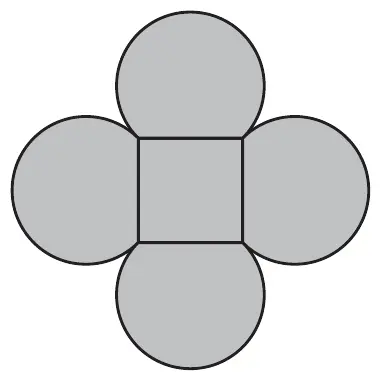
Hamilton Olympiad 2017, Question 1. © UK Mathematics Trust. Original paper on ukmt.org.uk
Answer: \((4 + 3\pi)\) cm2
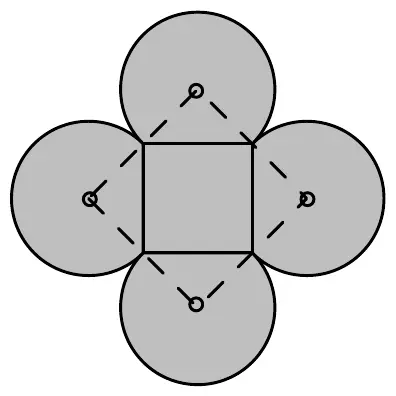
Join the centres of the circles, as shown in the diagram alongside, to form a quadrilateral whose sides have length 1 cm + 1 cm. Each angle of this quadrilateral is equal to 90° from the converse of Pythagoras' Theorem, since we are given the ‘inner’ square has sides of length \(\sqrt{2}\) cm. Because it has equal sides. it follows that the quadrilateral is a square.
The shaded region comprises this square and four sectors of circles, each of radius 1 cm and angle 270°, thus its area is equal to \(2 \times 2 + 4 \times \tfrac{3}{4} \times \pi \times 1^2\), in cm2.
Therefore, in cm2, the shaded area is equal to \(4 + 3\pi\).
Solution © UK Mathematics Trust, from the Hamilton Olympiad 2017 solutions.