
Hamilton 2015 Q6
6. The diagram shows four identical white triangles symmetrically placed on a grey square. Each triangle is isosceles and right-angled.
The total area of the visible grey regions is equal to the total area of the white triangles.
What is the smallest angle in each of the (identical) grey triangles in the diagram?
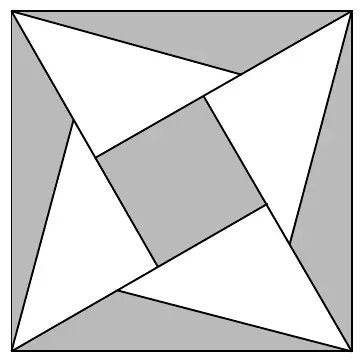
Hamilton Olympiad 2015, Question 6. © UK Mathematics Trust. Original paper on ukmt.org.uk
Answer: 15°
Choose the unit of measurement so that the two equal sides of each white triangle have length 1. Then the total area of the four white triangles is 2, because they can be assembled to form two squares of side 1.
Therefore the total area of the visible grey regions is also equal to 2, and hence the area of the original grey square is 4. Thus the sides of the grey square have length 2.
Now consider one of the triangles formed by one white triangle and an adjacent grey triangle, such as triangle \(ABC\) in Figure 1.
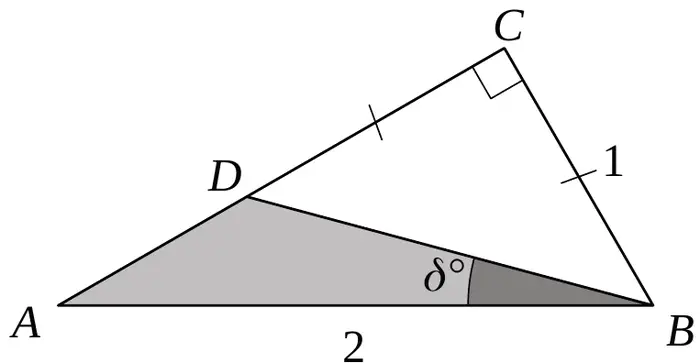
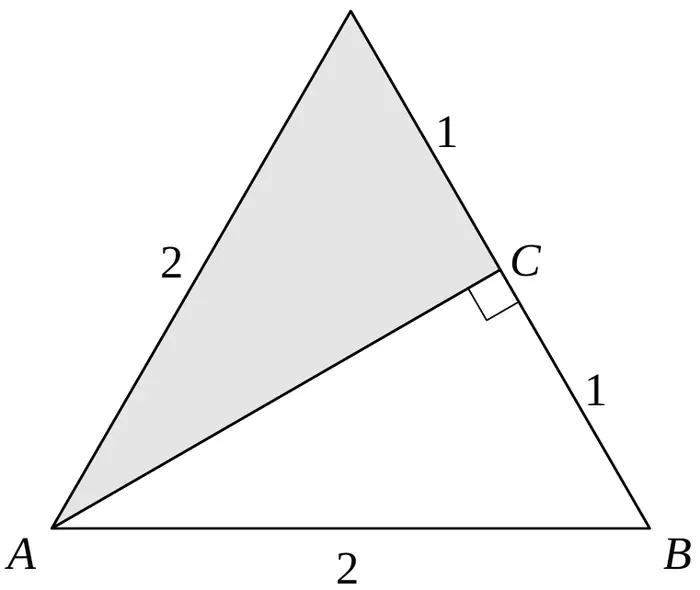
Figure 1 indicates what we know: the white triangle \(BCD\) is isosceles and right-angled; the length of \(AB\) is 2; and the length of \(BC\) is 1. We are asked to find the value of \(\delta^\circ\), which we shall find as the difference between \(\angle ABC\) and \(\angle DBC\).
Each of the equal angles in an isosceles right-angled triangle is 45° (from ‘base angles of an isosceles triangle’ and ‘the sum of the angles in a triangle is 180°’). Therefore \(\angle DBC = 45^\circ\).
In triangle \(ABC\), which is right-angled, the length of the hypotenuse is 2, and another side has length 1. It follows that triangle \(ABC\) is half an equilateral triangle, as shown in Figure 2. But each angle in an equilateral triangle is 60°, so that \(\angle ABC = 60^\circ\).
Hence \(\delta = 60 - 45\), and therefore the smallest angle in each grey triangle is 15°.
Solution © UK Mathematics Trust, from the Hamilton Olympiad 2015 solutions.