
A2 June 2024 Paper 1 Q9
9
The diagram below shows parts of the graphs of the curves with equations \(y = \left(\ln(1 + x)\right)^2\) and \(y = 2x^3\).
The curves intersect at the origin, \(O\), and at the point \(A\).
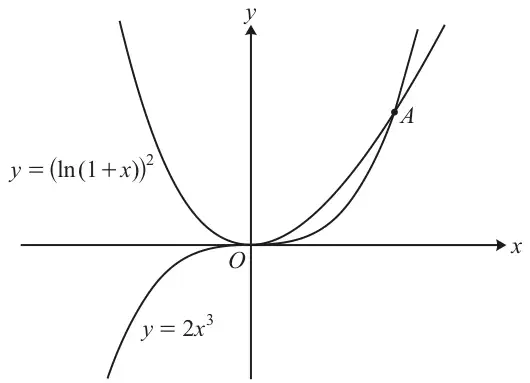
Use your answer to part (a) to determine an approximation for the value of the \(x\)-coordinate of \(A\). Give your answer to 2 decimal places. [3]
| Scheme | Marks | AO |
|---|---|---|
| \((\ln(1 + x))^2 = \left(x - \dfrac{x^2}{2} + \dfrac{x^3}{3} + \ldots\right)^2\) | M1 | 3.1a |
| \(= x^2 - x^3 + \ldots\) | B1 | 1.1 |
| \(\ldots + \dfrac{11}{12}x^4 + \ldots\) | A1 | 2.2a |
| [3] |
Notes
M1: Squaring the correct result for \(\ln(1 + x)\) with at least the first three terms.
B1: First two terms correct.
A1: Third term correct allow any equivalent fraction or exact decimal equivalent. ISW and ignore higher power terms.
Alternative method
| Scheme | Marks |
|---|---|
| \(\mathrm{f}(0) = 0\) and \(\mathrm{f}'(x) = \dfrac{2\ln(x + 1)}{x + 1}\) | M1 |
| \(\mathrm{f}'(0) = 0,\ \mathrm{f}''(0) = 2,\ \mathrm{f}'''(0) = -6\) | A1 |
| \((\ln(1 + x))^2 = x^2 - x^3 + \dfrac{11}{12}x^4 + \ldots\) | A1 |
| [3] |
M1: For \(\mathrm{f}(0) = 0\) and correct first derivative (or stating that the second derivative is zero too).
A1: Correct values for first, second and third derivatives
For reference: \(\mathrm{f}''(x) = \dfrac{2 - 2\ln(x + 1)}{(x + 1)^2}\) and \(\mathrm{f}'''(x) = \dfrac{2(-3 + 2\ln(x + 1))}{(x + 1)^3}\) and \(\mathrm{f}^{(4)}(x) = \dfrac{22 - 12\ln(x + 1)}{(x + 1)^4}\) and \(\mathrm{f}^{(4)}(0) = 22\).
A1: All terms correct (allow simplified or exact decimal equivalents for coefficients). ISW and ignore higher power terms.
| Scheme | Marks | AO |
|---|---|---|
| DR \(x^2 - x^3 + \dfrac{11}{12}x^4 + \ldots = 2x^3\) | M1* | 3.1a |
| \(x^2\left(1 - 3x + \dfrac{11}{12}x^2\right) = 0\) | M1dep* | 1.1 |
| \(x = 0.37(6690\ldots)\) or \(2.89(6036\ldots)\) but \(x = 0.38\) as expansion is only valid for \(-1 \lt x \leqslant 1\). | A1 | 3.2a |
| [3] |
Notes
M1*: Setting their expansion from part (a) equal to \(2x^3\). Their expansion must have at least three terms with non-zero quadratic, cubic and quartic terms.
M1dep*: Rearranging and factorising (allow sign slips only). Ignore higher order terms if the factor of \(x^2\) is seen – their expansion must have contained no constant or linear terms. Stating their quadratic \(1 - 3x + \frac{11}{12}x^2 = 0\) is fine for this mark. Stating either non-zero root of the correct (or their) quadratic can imply this mark.
A1: Selects the smallest non-zero root (so must see both correct roots either exact \(\dfrac{18 \pm 8\sqrt{3}}{11}\) or to at least 2 decimal places) and justifies with interval for validity being \(-1 \lt x \leqslant 1\). Allow awrt 0.38 or \(\dfrac{18 - 8\sqrt{3}}{11}\).
Condone any indication that expansion is only valid between values of \(-1\) and 1 or for values less than, or less than or equal, to 1.
Note that including \(x^5\) terms in expansion gives \(x = 0.35997\) and including \(x^5\) and \(x^6\) terms in expansion give \(x = 0.36504\). Ignore any attempt to work out corresponding \(y\)-coordinate.