
June 2023 Paper 3 Q9
9
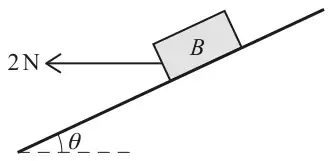
A block \(B\) of weight \(10\,\mathrm{N}\) lies at rest in equilibrium on a rough plane inclined at \(\theta\) to the horizontal. A horizontal force of magnitude \(2\,\mathrm{N}\), acting above a line of greatest slope, is applied to \(B\) (see diagram).
It is given that \(B\) remains at rest and the coefficient of friction between \(B\) and the plane is 0.8.
| Scheme | Marks | AO |
|---|---|---|
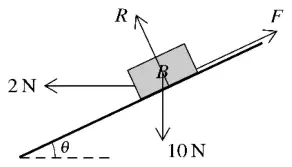 | B1 | 1.2 |
| [1] |
Notes
B1: Correct force diagram showing the weight, normal contact, and frictional contact forces only (but ignore labelling of these forces even if labelled incorrectly) but must include all arrows pointing in the correct direction – the line of action of all forces must pass through the block (or imply passing through the block) but do not need to be attached to the block
Ignore components of any of the three forces if shown – if only components shown then B0
| Scheme | Marks | AO |
|---|---|---|
| M1* | 3.3 | |
| \(R + 2\sin\theta = 10\cos\theta\) \(F = 2\cos\theta + 10\sin\theta\) | A1 A1 | 1.1 1.1 |
| \(2\cos\theta + 10\sin\theta \leqslant 0.8(10\cos\theta - 2\sin\theta)\) | M1dep* | 3.4 |
| \(10\cos\theta + 50\sin\theta \leqslant 40\cos\theta - 8\sin\theta\) \(\left(\tan\theta \leqslant \frac{30}{58} \Rightarrow \text{greatest value of}\right)\ \tan\theta\) is \(\frac{15}{29}\) | A1 | 2.2a |
| [5] |
Notes
M1*: Resolving parallel or perpendicular to the plane – correct number of terms - must be using 10 for the weight so no marks until this value used/applied (however, see SC in the final A mark)
Allow sin/cos confusion and sign errors – but the 2 and 10 must be resolved and the \(R\) and \(F\) should not (if considering \(\perp\) & \(\parallel\))
A1 A1: Condone \(\leqslant\) or \(\geqslant\) with \(F\) for this mark but withhold the final A mark
Where \(R\) is the normal contact force and \(F\) is the frictional contact force
M1dep*: Applying \(F \leqslant \mu R\) or \(F = \mu R\) to obtain an equation/inequality in \(\theta\) only – where \(R\) and \(F\) are a linear combination of the correct number of relevant resolved terms
A1: oe e.g. \(\frac{30}{58}\) but A0 for \(\frac{6}{11.6}\) as a final answer. Allow awrt 0.517. Isw if candidates go on to work out \(\theta\). Allow \(\tan\theta \leqslant \frac{15}{29}\) (oe) as a final answer
Can use equals throughout (no justification required) But not \(\tan\theta \lt \frac{15}{29}\)
If using \(10g\) for the weight, then SC M1* A1 A0 M1dep* A0 max (where the first A mark is for both equations correct using \(10g\) rather than 10)
Alternative for first three marks
| Scheme | Marks |
|---|---|
| Resolving vertically and horizontally | M1* |
| \(R\cos\theta + F\sin\theta = 10\) | A1 |
| \(F\cos\theta = 2 + R\sin\theta\) | A1 |
M1*: M1 conditions as above
A1: Final M1dep* and A marks as above