
October 2021 Paper 1 Q8
8 Kareem wants to solve the equation \(\sin 4x + \mathrm{e}^{-x} + 0.75 = 0\). He uses his calculator to create the following table of values for \(\mathrm{f}(x) = \sin 4x + \mathrm{e}^{-x} + 0.75\).
| \(x\) | 0 | 1 | 2 | 3 | 4 | 5 | 6 |
|---|---|---|---|---|---|---|---|
| \(\mathrm{f}(x)\) | 1.750 | 0.361 | 1.875 | 0.263 | 0.480 | 1.670 | \(-0.153\) |
He argues that because \(\mathrm{f}(6)\) is the first negative value in the table, there is a root of the equation between 5 and 6.
The diagram shows the graph of \(y = \sin 4x + \mathrm{e}^{-x} + 0.75\).
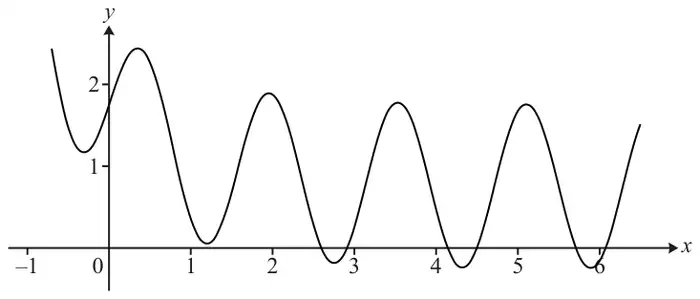
Kareem decides to use the Newton-Raphson method to find the root close to 3.
Kareem uses the Newton-Raphson method with \(x_0 = 5\) and also with \(x_0 = 6\) to try to find the root which lies between 5 and 6. He produces the following tables.
| \(x_0\) | 5 |
|---|---|
| \(x_1\) | 3.97288 |
| \(x_2\) | 4.12125 |
| \(x_0\) | 6 |
|---|---|
| \(x_1\) | 6.09036 |
| \(x_2\) | 6.07110 |
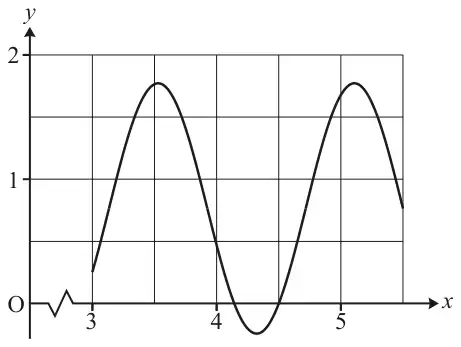
The graph in the Printed Answer Booklet:
| Scheme | Marks | AO |
|---|---|---|
| Karim has a valid argument that there is a root between 5 and 6 because there is a change of sign on his table | E1 | 2.3 |
| [1] |
Notes
E1: Argues from change of sign that this argument is valid
Allow argument is not valid as he does not state that the function is continuous
| Scheme | Marks | AO |
|---|---|---|
| There are two roots between 2 and 3 (and/or between 4 and 5) so there is no change of sign in the table | E1 | 2.3 |
| [1] |
Notes
E1: Allow for a comment that implies changes of sign are missed
| Scheme | Marks | AO | ||||||||
|---|---|---|---|---|---|---|---|---|---|---|
| (i) \(\mathrm{f}^\prime(x) = 4\cos 4x - \mathrm{e}^{-x}\) | M1 | 1.1b | ||||||||
| So N-R formula is \(x_{n+1} = x_n - \dfrac{\sin 4x_n + \mathrm{e}^{-x_n} + 0.75}{4\cos 4x_n - \mathrm{e}^{-x_n}}\) | A1 | 1.1b | ||||||||
| [2] | ||||||||||
(ii)
| M1 A1 A1 | 1.1b 1.1b 2.2a | ||||||||
| [3] |
Notes
(i) M1: Attempt to differentiate
A1: cao, but condone missing subscripts in the fraction
(ii) M1: Produces at least two iterations
A1: Three iterations with correct values either rounded or truncated to at least 3 decimal places
A1: Correct to at least 3 s.f. FT their values if their sequence seems to converge
(root is 2.907845109 to 10 sf)
| Scheme | Marks | AO |
|---|---|---|
(i) 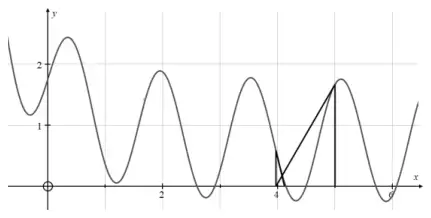 | B1 B1 | 1.1b 1.1b |
| [2] | ||
| (ii) The start value is close to a stationary point, [so the gradient is very small] and the tangent meets the \(x\)-axis far away from the required root | B1 | 2.4 |
| The sequence converges to a root, but not the required root | B1 | 2.4 |
| [2] | ||
| (iii) Use \(x_0\) any value [between 5.28 and 5.85] which is nearer to the required root. | E1 | 2.4 |
| [1] |
Notes
(i) B1: Attempt to draw a tangent at \(x = 5\) as far as the \(x\)-axis
B1: Drawing the second tangent approximately at the point where \(x = 3.97\) as far as the \(x\)-axis.
(ii) B1: Conveys the idea that the stationary point or the value of the gradient causes the problem
B1: Conveys the idea that the wrong root is found
(iii) E1: Allow for a ‘starting value between 5 and 6’ oe