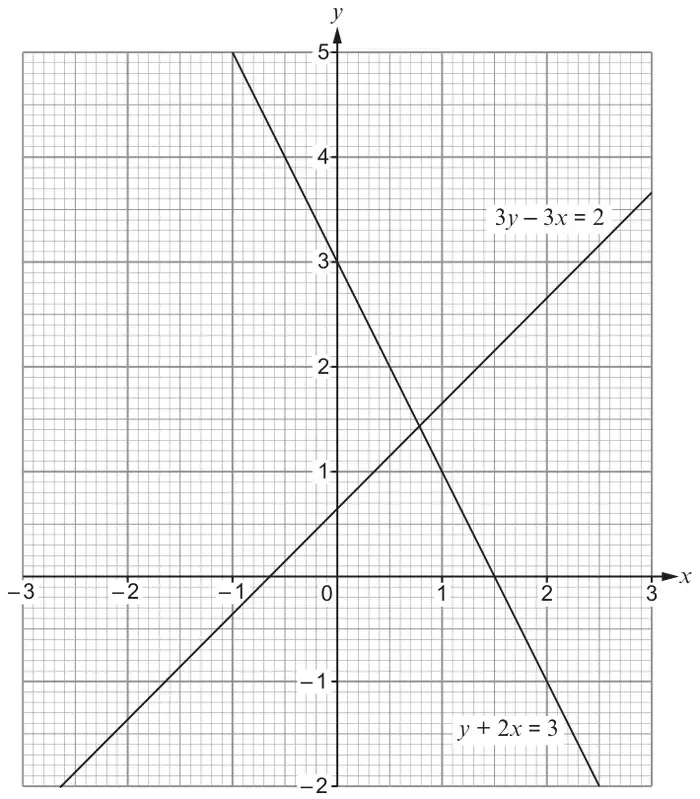
(a)Use the diagram to solve the following simultaneous equations.\[\begin{gathered}3y - 3x = 2\\ y + 2x = 3\end{gathered}\]Give your answers correct to 1 decimal place. [2]
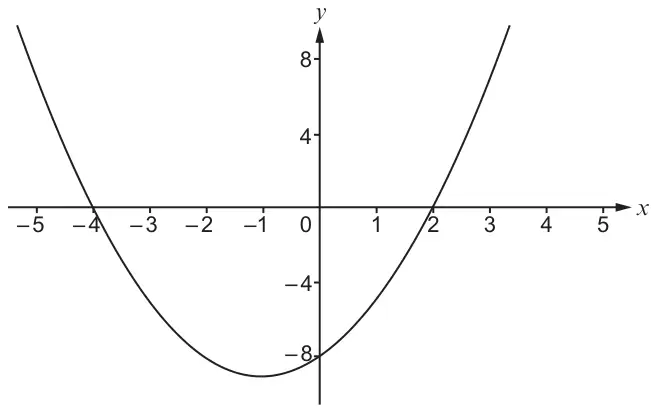
(b) The diagram shows the curve \(y = x^2 + 2x - 8\).
(i) Write down the \(y\)-intercept of the curve. [1]
(ii) Find the coordinates of the turning point of the curve. [2]
(iii) Use the diagram to solve \(x^2 + 2x - 8 = 0\). [1]
Mark scheme (a)
Scheme
Marks
Comments
\(x =\) 0.7 or 0.8
B1
\(y =\) 1.4 or 1.5
B1
If no marks award SC1 for one of the following:
a value of \(x\) between 0·7 and 0·8 (including 7/9) and a value of \(y\) between 1·4 and 1·5 (including \(1\tfrac{4}{9}\) or \(\tfrac{13}{9}\)),
correct values given as coordinates in the working lines,
correct answers, written to 1 decimal place, reversed.
Mark scheme (b)
Scheme
Marks
Comments
(i) −8
B1
Allow (0, −8) or \(y = -8\)
(ii) (−1, −9)
B2
B1 for each.
If no final coordinate given, allow:
B2 for an unambiguous \(x = -1\) AND \(y = -9\) seen in the working
B1 for an unambiguous \(x = -1\) OR \(y = -9\) seen in the working
If no marks, award SC1 for (−9, −1).
(iii) \(x = -4,\ x = 2\)
B1
If answer line is not completed, allow −4, 2, but do not allow (−4, 2)
We'd like to use Google Analytics cookies to count visits and see which pages help most. They're optional, and the site works exactly the same either way. Privacy policy