
Foundation June 2024 Paper 2 Q20
20. When a ball is dropped, the maximum height it reaches after each bounce decreases.
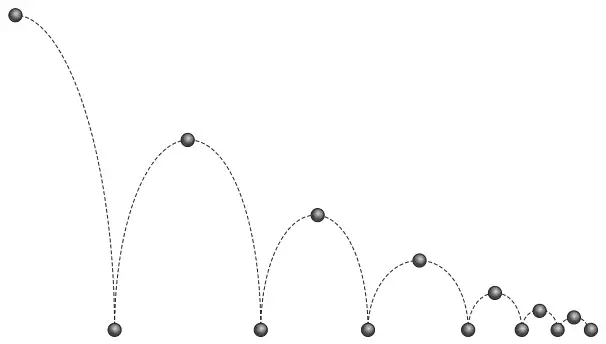
Diagram not drawn to scale
Maddox says,
| Each time the ball bounces it reaches a height that is 55% of the maximum height reached on its previous bounce. |
(a)
The ball is dropped from a height of 4 m.
What height will the ball reach above the ground after its 7th bounce? [3]
(b)
(i) State any assumptions you have made in answering part (a). [1]
(ii) What effect could your assumption have on your answer to part (a)? [1]
| Scheme | Marks | Comments |
|---|---|---|
| \(4 \times 0.55^7\) \(400 \times 0.55^7\) | M2 | M1 for \(4 \times 0.55^n\) or \(400 \times 0.55^n\) where \(1 \leqslant n \lt 9\) |
| = 0.06089… or 0.0609 (m) 6.089….. or 6.09 (cm) | A1 | CAO. If units are given, they must be correct. Mark final answer. Accept 0.061 or 0.06 (m), 6.1 or 6 (cm) from correct working provided no inaccurate working seen. If no marks, award SC1 for an answer of 0.0149.. or 0.015 (m) or 1.49.. or 1.5 (cm) (from \(4 \times 0.45^7\) or \(400 \times 0.45^7\)) |
| Scheme | Marks | Comments |
|---|---|---|
| (i) A correct assumption e.g. ‘The surface it bounces on is the same on each bounce.’ ‘The ball bounces on level ground.’ ‘That the 55% is correct for all bounces.’ ‘No energy is lost elsewhere.’ ‘There is no wind.’ ‘There was nothing in the way.’ | E1 | Allow e.g. ‘It is flat.’ – implies the surface ‘No other forces acting on the ball.’ ‘Nothing interfered with the bouncing.’ Do not allow e.g. ‘It was dropped without force.’ ‘The ball is dropped with the same force every time.’ |
| (ii) A correct effect of the assumption e.g. ‘There will be no change to my answer.’ | E1 | If no valid assumption is made, then this mark cannot be awarded. Cannot award E0 E1. The effect must follow their assumption. |
| (5) |