S1 June 2014 Q8
8. For the events \(A\) and \(B\),
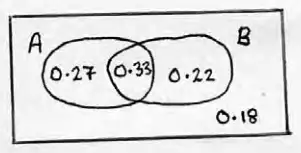
\[\mathrm{P}(A^{\prime} \cap B) = 0.22 \quad \text{and} \quad \mathrm{P}(A^{\prime} \cap B^{\prime}) = 0.18\]Given that \(\mathrm{P}(A \mid B) = 0.6\)
| Scheme | Marks |
|---|---|
| \([\mathrm{P}(A) = 1 - 0.18 - 0.22] = \mathbf{0.6}\) (or exact equivalent) | B1 |
| (1) |
| Scheme | Marks |
|---|---|
| \(\mathrm{P}(A \cup B) = \text{"}0.6\text{"} + 0.22 = \mathbf{0.82}\) (or exact equivalent) | B1ft |
| (1) |
Notes
B1ft for their (a) + 0.22 or \(1 - \mathrm{P}(A^{\prime} \cap B^{\prime})\) Do not ft their (a) if it is > 0.78
| Scheme | Marks |
|---|---|
| \(x = \mathrm{P}(A \cap B)\) \(\dfrac{x}{x + 0.22} = 0.6\) | M1 |
| \(x = 0.6x + 0.132\) \(0.4x = 0.132\) | dM1 |
| \(x = \mathbf{0.33}\) (or exact equivalent) | A1cso |
| (3) |
Notes
NB 3 versions for (c). Check carefully that Ms are genuinely scored.
Look out for assuming independence and if you see P(\(B\)) = 0.55 check it is derived properly
1st M1 for a correct equation for \(x\) e.g. \(\dfrac{x}{x + 0.22} = 0.6\) or a correctly derived equation for \(\mathrm{P}(B)\)
2nd dM1 for solving to get in form \(kx = L\) or correct use of \(\mathrm{P}(B)\) to find \(\mathrm{P}(A \cap B)\) [2nd or 3rd ver] or \(\mathrm{P}(A \cap B) = \mathrm{P}(B) - 0.22\)
A1cso for 0.33 Dep. on both Ms and no incorrect working seen.
Alternative (2nd version)
| Scheme | Marks |
|---|---|
| Use \(\mathrm{P}(B)\mathrm{P}(A^{\prime} \mid B) = \mathrm{P}(A^{\prime} \cap B)\) \(\mathrm{P}(B)\times[1 - 0.6] = 0.22\) | M1 |
| Use \(\mathrm{P}(A \cap B) = \mathrm{P}(A \mid B)\mathrm{P}(B)\) \(\mathrm{P}(A \cap B) = 0.6\times 0.55\) | dM1 |
| \(x = \mathbf{0.33}\) | A1cso |
Alternative (3rd version)
| Scheme | Marks |
|---|---|
| Establish independence before or after 1st M1and score marks for (d) (RH ver) Find \(\mathrm{P}(B)\) | M1 |
| Use \(\mathrm{P}(B)\mathrm{P}(A) = \mathrm{P}(A \cap B)\) \(\mathrm{P}(A \cap B) = 0.6\times 0.55\) | dM1 |
| \(x = \mathbf{0.33}\) | A1cso |
| Scheme | Marks |
|---|---|
| \(\mathrm{P}(B) = 0.55\) \(\mathrm{P}(B)\times\mathrm{P}(A) = 0.55\times 0.6 = 0.33\) or stating \(\mathrm{P}(A) = \mathrm{P}(A \mid B)\) [= 0.6] | M1 |
| \(\mathrm{P}(B)\times\mathrm{P}(A) = \mathrm{P}(A \cap B)\) therefore (statistically) independent or \(\mathrm{P}(A) = \mathrm{P}(A \mid B)\) therefore (statistically) independent | A1cso |
| (2) | |
| (7 marks) |
Notes
M1 for finding \(\mathrm{P}(B)\times\mathrm{P}(A) = 0.33\) (values needed) or stating \(\mathrm{P}(A) = \mathrm{P}(A \mid B)\) (= 0.6 not needed)
A1cso for a correct statement: \(\mathrm{P}(B)\times\mathrm{P}(A) = \mathrm{P}(A \cap B)\) or \(\mathrm{P}(A) = \mathrm{P}(A \mid B)\) and stating independent
NB The M1 in (d) using \(\mathrm{P}(A \cap B)\) requires \(\mathrm{P}(B) = 0.55\). There is no ft of an incorrect \(\mathrm{P}(B)\). Full marks in (d) is OK even if 0/3 in (c)
{This Venn diagram may be helpful.}