
S1 June 2013 Q3
3. In a company the 200 employees are classified as full-time workers, part-time workers or contractors.
The table below shows the number of employees in each category and whether they walk to work or use some form of transport.
| Walk | Transport | |
|---|---|---|
| Full-time worker | 2 | 8 |
| Part-time worker | 35 | 75 |
| Contractor | 30 | 50 |
The events \(F\), \(H\) and \(C\) are that an employee is a full-time worker, part-time worker or contractor respectively. Let \(W\) be the event that an employee walks to work.
An employee is selected at random.
Find
Let \(B\) be the event that an employee uses the bus.
Given that 10% of full-time workers use the bus, 30% of part-time workers use the bus and 20% of contractors use the bus,
| Scheme | Marks |
|---|---|
| \(\dfrac{35 + 75}{200} = 0.55\) | M1 A1 |
| (2) |
Notes
Correct answers only score full marks for each part
If a probability is not in [0, 1] award M0
M1 for denominator of 200 and attempt to add 2 + 8 or 35 + 75 or 30 + 50
A1 for 0.55 or exact equivalent fraction e.g. \(\frac{11}{20}\)
| Scheme | Marks |
|---|---|
| \(\dfrac{200 - 2}{200} = 0.99\) | M1 A1 |
| (2) |
Notes
M1 for a fully correct expression ( e.g. \(1 - 0.01\))
A1 for 0.99 or an exact equivalent fraction
| Scheme | Marks |
|---|---|
| \([\mathrm{P}(W \mid C)] = \dfrac{\mathrm{P}(W \cap C)}{\mathrm{P}(C)} = \dfrac{30/200}{80/200} = \dfrac{30}{80} = 0.375\) | M1 A1 |
| (2) |
Notes
M1 for a correct ratio or a correct formula and at least one correct prob (i.e. a correct num or denom). BUT award M0 if num is \(\mathrm{P}(W)\times\mathrm{P}(C) = \frac{67}{200}\times\frac{80}{200}\) or if num>denom
A1 for 0.375 or 3/8 or any exact equivalent.
| Scheme | Marks |
|---|---|
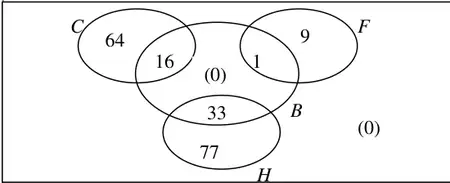 If their diagram indicates extra empty regions do not treat a blank as 0. | M1 B1 for 9, 1 B1 for 77, 33 B1 for 64, 16 |
| (4) |
Notes
M1 for a box and the 3 regions \(F\), \(C\) and \(H\) labelled or implied and single set \(B\) labelled. There should be no intersections between \(F\), \(C\) and \(H\) unless marked by zeros. They may have 3 circles for \(F\), \(C\) and \(B\) with \(H = F^{\prime} \cap C^{\prime}\) etc. Condone lack of zero in the given diagram.
\(F\) 1st B1 for the 9 and 1 or 0.045 and 0.005 (o.e.) in the correct regions
\(H\) 2nd B1 for the 77 and 33 or 0.385 and 0.165 (o.e.) in the correct regions
\(C\) 3rd B1 for the 64 and 16 or 0.32 and 0.08 (o.e.) in the correct regions.
May have \(B\) in 3 bits that are disconnected.
| Scheme | Marks |
|---|---|
| \(\dfrac{1 + 16 + 33}{200} = 0.25\) | M1 A1 |
| (2) | |
| (12 marks) |
Notes
M1 for a numerator made up of their 1 + their 16 + their 33 and a denom of 200 and num < 200
Also allow sum of their probabilities (provided sum < 1)
A1 for 0.25 or any exact equivalent