
S1 January 2006 Q4
4. A bag contains 9 blue balls and 3 red balls. A ball is selected at random from the bag and its colour is recorded. The ball is not replaced. A second ball is selected at random and its colour is recorded.
(a) Draw a tree diagram to represent the information. (3)
Find the probability that
(b) the second ball selected is red, (2)
(c) both balls selected are red, given that the second ball selected is red. (2)
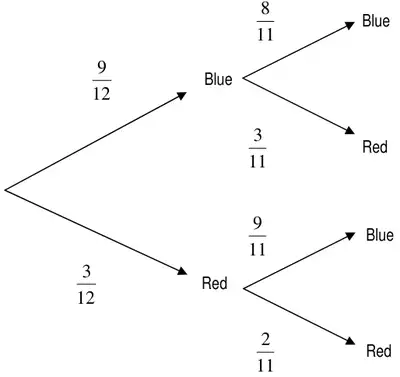
| Scheme | Marks |
|---|---|
| Tree | M1 |
| \(\dfrac{9}{12}, \dfrac{3}{12}\) | A1 |
| Complete & labels | A1 |
| (3) |
| Scheme | Marks |
|---|---|
| \(\mathrm{P}(\text{Second ball is red}) = \dfrac{9}{12} \times \dfrac{3}{11} + \dfrac{3}{12} \times \dfrac{2}{11} = \dfrac{1}{4}\) | M1A1 |
| (2) |
| Scheme | Marks |
|---|---|
| \(\mathrm{P}(\text{Both are red} \mid \text{Second ball is red}) = \dfrac{\frac{3}{12} \times \frac{2}{11}}{\frac{1}{4}} = \dfrac{2}{11}\) | M1A1 |
| (2) | |
| (7 marks) |
Notes
A1 exact or awrt 0.182
The question paper labels the parts (a), (a), (b); the mark scheme labels them (a), (b), (c), which is used here.