
M5 June 2006 Q7
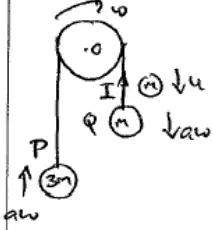
7. Particles \(P\) and \(Q\) have mass \(3m\) and \(m\) respectively. Particle \(P\) is attached to one end of a light inextensible string and \(Q\) is attached to the other end. The string passes over a circular pulley which can freely rotate in a vertical plane about a fixed horizontal axis through its centre \(O\). The pulley is modelled as a uniform circular disc of mass \(2m\) and radius \(a\). The pulley is sufficiently rough to prevent the string slipping. The system is at rest with the string taut. A third particle \(R\) of mass \(m\) falls freely under gravity from rest for a distance \(a\) before striking and adhering to \(Q\). Immediately before \(R\) strikes \(Q\), particles \(P\) and \(Q\) are at rest with the string taut.
When \(R\) strikes \(Q\), there is an impulse in the string attached to \(Q\).
Given that \(P\) does not hit the pulley,
| Scheme | Marks |
|---|---|
| \(u = \sqrt{2ag}\) | B1 |
| CAM about \(O\): \(m\sqrt{2ag}\,a = 2ma^2\omega + 3ma^2\omega + \tfrac{1}{2}2ma^2\omega\) | M1 A2 |
| \(\dfrac{\sqrt{2ag}}{6a} = \omega\) | |
| \(\dfrac{1}{3}\sqrt{\dfrac{g}{2a}} = \omega\) * | A1 |
| (5) |
| Scheme | Marks |
|---|---|
| For \(Q\): \(-I = 2ma\omega - mu\) | M1 A1 |
| \(\Rightarrow\ I = 6ma\omega - 2ma\omega = 4ma\omega\) | |
| \(= \dfrac{4ma}{3}\sqrt{\dfrac{g}{2a}} = \dfrac{m}{3}\sqrt{8ag}\) | A1 |
| (3) |
| Scheme | Marks |
|---|---|
| PE Gain of \(P\) = KE loss of \(P\) + KE loss of \(Q\) + KE loss of pulley + PE loss of \(Q\) | |
| \(3mgd = \tfrac{1}{2}3ma^2\omega^2 + \tfrac{1}{2}2ma^2\omega^2 + \tfrac{1}{2}ma^2\omega^2 + 2mgd\) | M1 A3 |
| \(gd = 3a^2\omega^2\) | |
| \(gd = 3a^2\cdot\dfrac{1}{9}\dfrac{g}{2a}\), \(d = \dfrac{a}{6}\) | M1 A1 |
| (6) | |
| (14 marks) |
Notes
The printed scheme writes the last line as \(gd = 3a^2\cdot\frac{1}{9}\frac{g}{2a} = \frac{a}{6}\); the distance is \(d = \frac{a}{6}\).