
M4 June 2006 Q7
7.
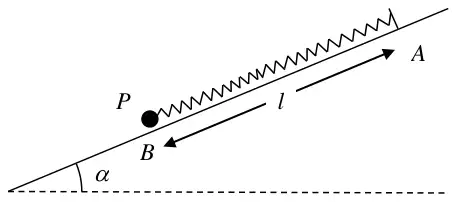
A light elastic spring has natural length \(l\) and modulus of elasticity \(4mg\). One end of the spring is attached to a point \(A\) on a plane that is inclined to the horizontal at an angle \(\alpha\), where \(\tan\alpha = \tfrac{3}{4}\). The other end of the spring is attached to a particle \(P\) of mass \(m\). The plane is rough and the coefficient of friction between \(P\) and the plane is \(\tfrac{1}{2}\). The particle \(P\) is held at a point \(B\) on the plane where \(B\) is below \(A\) and \(AB = l\), with the spring lying along a line of greatest slope of the plane, as shown in Figure 4. At time \(t = 0\), the particle is projected up the plane towards \(A\) with speed \(\tfrac{1}{2}\sqrt{(gl)}\). At time \(t\), the compression of the spring is \(x\).
| Scheme | Marks |
|---|---|
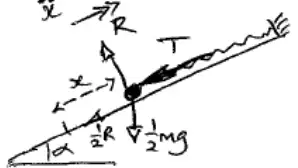
| \(F = \dfrac{1}{2}R\) | M1 |
| \(R = mg\cos\alpha\) | B1 |
| \(T = \dfrac{4mgx}{l}\) | B1 |
| \((\nearrow)\colon\ -F - mg\sin\alpha - T = m\ddot{x}\) | M1 A1 |
| \(-\dfrac{1}{2}.\dfrac{4}{5}mg - \dfrac{3}{5}mg - \dfrac{4mgx}{l} = m\ddot{x}\) | |
| \(\Rightarrow \dfrac{d^2x}{dt^2} + 4\omega^2x = -g\ \ *\qquad \left(\omega = \sqrt{g/l}\right)\) | A1 |
| (6) |
Notes
The published mark scheme for this paper is handwritten.
| Scheme | Marks |
|---|---|
| \(m^2 + 4\omega^2 = 0 \Rightarrow m = \pm 2\omega\mathrm{i}\) | |
| C.F. is \(\ x = A\sin 2\omega t + B\cos 2\omega t\) | M1 |
| P.I. is \(\ x = \dfrac{-g}{4\omega^2} = -l/4\) | B1 |
| G.S. is \(\ x = A\sin 2\omega t + B\cos 2\omega t - \dfrac{l}{4}\) | B1 |
| \(t = 0,\ x = 0\colon\ \ B = l/4\) | |
| \(\dot{x} = 2\omega A\cos 2\omega t - 2\omega B\sin 2\omega t\) | M1 A1 |
| \(t = 0,\ \dot{x} = \tfrac{1}{2}\sqrt{gl}\colon\ \ \dfrac{\sqrt{gl}}{2} = 2\sqrt{\dfrac{g}{l}}A \Rightarrow A = l/4\) | M1 |
| \(\Rightarrow x = \dfrac{l}{4}(\sin 2\omega t + \cos 2\omega t - 1)\) | A1 |
| (7) |
| Scheme | Marks |
|---|---|
| \(\dot{x} = 0 \Rightarrow 2\omega A\cos 2\omega t - 2\omega B\sin 2\omega t = 0\) | M1 |
| \(\Rightarrow \tan 2\omega t = \dfrac{A}{B} = 1\) | |
| \(\Rightarrow 2\omega t = \pi/4\quad\) (first value) | A1 |
| \(\Rightarrow x = \dfrac{l}{4}\left(\dfrac{\sqrt{2}}{2} + \dfrac{\sqrt{2}}{2} - 1\right)\) | M1 |
| \(= \dfrac{l}{4}\left(\sqrt{2} - 1\right)\) | A1 |
| (4) | |
| (17 marks) |