
M3 June 2016 Q5
5.
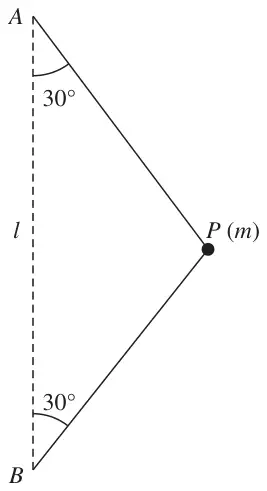
A particle \(P\) of mass \(m\) is attached to the ends of two light inextensible strings. The other ends of the strings are attached to fixed points \(A\) and \(B\), where \(B\) is vertically below \(A\) and \(AB = l\). The particle is moving with constant angular speed \(\omega\) in a horizontal circle. Both strings are taut and inclined at 30\(^\circ\) to \(AB\), as shown in Figure 3.
| Scheme | Marks |
|---|---|
| \(T_A\cos 30^\circ = mg + T_B\cos 30^\circ\) | M1A1 |
| \(T_A - T_B = \dfrac{2mg}{\sqrt{3}}\) | |
| Radius \(= \dfrac{1}{2}l\tan 30^\circ \quad \left(= \dfrac{\sqrt{3}}{6}l\ \text{ oe}\right)\) | B1 |
| \(T_A\cos 60^\circ + T_B\cos 60^\circ = mr\omega^2 = m\left(\dfrac{1}{2}l\tan 30^\circ\right)\omega^2\) | M1A1A1ft |
| \(T_A + T_B = \dfrac{ml\omega^2}{\sqrt{3}}\) | |
| (i) \(T_A = \dfrac{1}{2}\left(\dfrac{2mg}{\sqrt{3}} + \dfrac{ml\omega^2}{\sqrt{3}}\right) = \dfrac{m\sqrt{3}}{6}\left(2g + l\omega^2\right)\) * | DM1A1cso |
| (ii) \(T_B = \dfrac{1}{2}\left(\dfrac{ml\omega^2}{\sqrt{3}} - \dfrac{2mg}{\sqrt{3}}\right)\) oe | A1cso |
| (9) |
Notes
M1 Attempt a vertical equation, can have \(\theta\) for the angle
A1 Completely correct equation, must have numerical angle now
B1 Correct radius seen anywhere
M1 NL2 along the radius. Acceleration in either form and can have \(r\) for the radius
A1 Correct sum of tensions (may have a tension on each side)
A1ft Correct mass x acceleration, follow through their radius
(i)DM1 Solve the equations to either \(T_A = \ldots\) or \(T_B = \ldots\) Dependent on both previous M marks. Can be awarded for finding \(T_A\) or \(T_B\)
A1cso Correct expression for \(T_A\) Given answer so no equivalents allowed.
(ii)A1 cso Correct expression for \(T_B\). Any equivalent 2 term expression allowed.
Special case If only one of vertical and radial equations found and the given \(T_A\) used to find \(T_B\), award the marks earned for the equation and radius, if used, and B1 for \(T_B\) (last A1 in (a) on e-PEN) Max score 5/9
| Scheme | Marks |
|---|---|
| \(T_B > 0 \qquad 2mg < ml\omega^2\) | M1 |
| \(\omega^2 > \dfrac{2g}{l}\) | A1 |
| \(T = \dfrac{2\pi}{\omega} \qquad T < 2\pi\sqrt{\dfrac{l}{2g}} = \pi\sqrt{\dfrac{2l}{g}}\) * | DM1A1cso |
| (4) | |
| (13 marks) |
Notes
M1 Deducing an inequality from the expression for \(T_B\) Can have \(2(m)g < (m)l\omega^2\) or \(2(m)g \leqslant (m)l\omega^2\) or \(2(m)g = (m)l\omega^2\)
A1 \(\omega^2 > \dfrac{2g}{l}\) or \(\omega^2 \geqslant \dfrac{2g}{l}\) oe inc equivalent in words.
DM1 Use \(T = \dfrac{2\pi}{\omega}\) with their \(\omega\) to form an inequality for \(T\), can have \(T < \ldots\) or \(T \leqslant \ldots\)
Dependent on the first M mark of (b)
A1cso For a correct final statement from a correct solution. Must be \(T < \ldots\) or equivalent in words