
M3 June 2014 Q5
5.
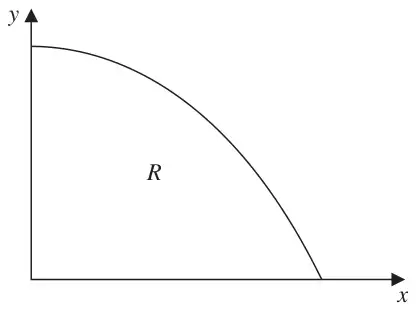
Figure 4 shows the region \(R\) bounded by part of the curve with equation \(y = \cos x\), the \(x\)-axis and the \(y\)-axis. A uniform solid \(S\) is formed by rotating \(R\) through \(2\pi\) radians about the \(x\)-axis.
| Scheme | Marks |
|---|---|
| Vol \(= \pi\displaystyle\int_0^{\frac{\pi}{2}} y^2\,\mathrm{d}x = \pi\int_0^{\frac{\pi}{2}} \cos^2 x\,\mathrm{d}x\) | M1 |
| \(= \pi\displaystyle\int_0^{\frac{\pi}{2}} \frac{1}{2}(\cos 2x + 1)\,\mathrm{d}x\) | M1 |
| \(= \dfrac{\pi}{2}\left[\dfrac{1}{2}\sin 2x + x\right]_0^{\frac{\pi}{2}} = \dfrac{\pi^2}{4}\) | DM1A1 |
| (4) |
Notes
M1 for using Vol \(= \pi\displaystyle\int_0^{\frac{\pi}{2}} \cos^2 x\,\mathrm{d}x\). If \(\pi\) is missing here it must be included later to earn this mark. Limits not needed
M1 for using the double angle formula (correct) to prepare for integration. Formula must be correct. \(\pi\) and limits not needed for this mark.
M1 dep for attempting to integrate and substitute the correct limits (only sub of non-zero limit needed be to seen) dependent on both M marks.
A1 cso for \(\dfrac{\pi^2}{4}\) * (check integration is correct, answer can be obtained by luck due to the limits)
| Scheme | Marks |
|---|---|
| \(\pi\displaystyle\int_0^{\frac{\pi}{2}} y^2 x\,\mathrm{d}x = \pi\int_0^{\frac{\pi}{2}} x\cos^2 x\,\mathrm{d}x\) | M1 |
| \(= \pi\displaystyle\int_0^{\frac{\pi}{2}} \frac{1}{2}x(\cos 2x + 1)\,\mathrm{d}x\) | |
| \(= \dfrac{\pi}{2}\displaystyle\int_0^{\frac{\pi}{2}} x\cos 2x\,\mathrm{d}x + \frac{\pi}{2}\left[\frac{x^2}{2}\right]_0^{\frac{\pi}{2}}\) | |
| \(\dfrac{\pi}{2}\left[x \times \dfrac{1}{2}\sin 2x\right]_0^{\frac{\pi}{2}} - \dfrac{\pi}{2}\displaystyle\int_0^{\frac{\pi}{2}} \frac{1}{2}\sin 2x\,\mathrm{d}x,\ + \frac{\pi^3}{16}\) | M1,B1 |
| \(= 0 + \dfrac{\pi}{2}\left[\dfrac{1}{4}\cos 2x\right]_0^{\frac{\pi}{2}} + \dfrac{\pi^3}{16}\) | DM1 |
| \(= \dfrac{\pi}{8}[-1 - 1] + \dfrac{\pi^3}{16} = \dfrac{\pi^3}{16} - \dfrac{\pi}{4}\) | A1ft |
| \(\bar{x} = \dfrac{\pi^3 - 4\pi}{16} \div \dfrac{\pi^2}{4} = \dfrac{\pi^2 - 4}{4\pi}\) or 0.467088.... | M1A1 |
| (7) | |
| (11 marks) |
Notes
NB: The first 5 marks can be earned with or without \(\pi\)
M1 for using \(\pi\displaystyle\int_0^{\frac{\pi}{2}} x\cos^2 x\,\mathrm{d}x\) \(\pi\) not needed; limits not needed.
M1 for using the double angle formula (correct) and attempting the first stage of integration by parts
B1 for \(\dfrac{\pi^3}{16}\) or \(\dfrac{\pi^2}{16}\) if \(\pi\) not included. NB integration by parts not needed for this mark
M1 dep for completing the integration by parts, limits not needed yet
A1 ft for \(= \dfrac{\pi}{8}[-1 - 1] + \dfrac{\pi^3}{16} = \dfrac{\pi^3}{16} - \dfrac{\pi}{4}\) or \(= \dfrac{1}{8}[-1 - 1] + \dfrac{\pi^2}{16} = \dfrac{\pi^2}{16} - \dfrac{1}{4}\) ft on \(\dfrac{\pi^3}{16}\)
M1 for using \(\bar{x} = \dfrac{\displaystyle\int \pi y^2 x\,\mathrm{d}x}{\displaystyle\int \pi y^2\,\mathrm{d}x}\) The numerator integral need not be correct. \(\pi\) should be seen in both or neither integral
A1 cso for \(\bar{x} = \dfrac{\pi^2 - 4}{4\pi}\) oe eg \(\dfrac{\pi}{4} - \dfrac{1}{\pi}\) or 0.467088.... Accept 0.47 or better but no fractions within fractions
(a) has a given answer, so the cso applies to the solution of (b) only.