
M3 June 2013 Q7
7.
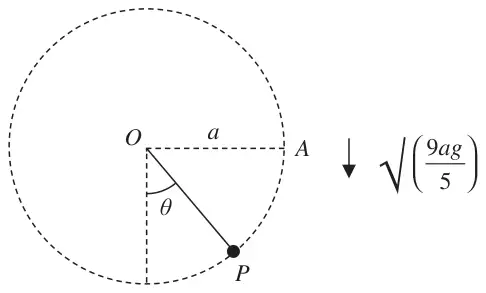
A particle \(P\) of mass \(5m\) is attached to one end of a light inextensible string of length \(a\). The other end of the string is attached to a fixed point \(O\). The particle is held at the point \(A\), where \(OA = a\) and \(OA\) is horizontal, as shown in Figure 6. The particle is projected vertically downwards with speed \(\sqrt{\left(\dfrac{9ag}{5}\right)}\). When the string makes an angle \(\theta\) with the downward vertical through \(O\) and the string is still taut, the tension in the string is \(T\).
At the instant when the particle reaches the point \(B\) the string becomes slack.
At time \(t = 0\), \(P\) is at \(B\).
At time \(t\), before the string becomes taut once more, the coordinates of \(P\) are \((x, y)\) referred to horizontal and vertical axes with origin \(O\). The \(x\)-axis is directed along \(OA\) produced and the \(y\)-axis is vertically upward.
| Scheme | Marks |
|---|---|
| \(T - 5mg\cos\theta = \dfrac{5mv^2}{a}\) | M1A1 |
| \(\dfrac{1}{2} \times 5mv^2 - \dfrac{1}{2} \times 5m \times \dfrac{9ag}{5} = 5mga\cos\theta\) | M1A1 |
| \(5mv^2 = 10mga\cos\theta + 9mga\) | |
| \(T = 5mg\cos\theta + 10mg\cos\theta + 9mg\) | M1dep |
| \(T = 3mg(5\cos\theta + 3)\) * | A1 |
| (6) |
Notes
M1 for attempting NL2 along the radius when the string makes an angle \(\theta\) with the downward vertical. The acceleration can be in either form, the weight must be resolved and \(T\) must be included (not resolved). Sin/cos interchange or omission of \(g\) are accuracy errors as is omission of 5 in one or both terms. Radius can be \(a\) or \(r\).
A1 for a correct equation \(T - 5mg\cos\theta = \dfrac{5mv^2}{a}\) Acceleration must be in the \(\dfrac{v^2}{r}\) form now.
M1 for a conservation of energy equation from the horizontal to the same point. There must be a difference of 2 KE terms and a loss of PE term (which may be indicated by a difference of 2 PE terms). The initial KE can be \(\dfrac{1}{2} \times \text{mass} \times \left(\sqrt{\dfrac{9ag}{3}}\right)^2\) or \(\dfrac{1}{2} \times \text{mass} \times u^2\) for this mark. Omission of \(g\) and sin/cos interchange are accuracy errosr. Mass can be \(m\) or \(5m\) here or just "mass". Use of \(v^2 = u^2 + 2as\) gets M0
A1 for a fully correct equation \(\dfrac{1}{2} \times (5m)v^2 - \dfrac{1}{2} \times (5m) \times \dfrac{9ag}{5} = (5m)ga\cos\theta\)
M1dep for eliminating \(v^2\) between the 2 equations. Dependent on both previous M marks.
A1cso for \(T = 3mg(5\cos\theta + 3)\) *
| Scheme | Marks |
|---|---|
| \(T = 0\ \ \ \cos\theta = -\dfrac{3}{5}\) | B1 |
| \(v^2 = \dfrac{9ag}{5} - \dfrac{6ag}{5} = \dfrac{3ag}{5}\) | M1 |
| \(v = \sqrt{\dfrac{3ag}{5}}\) | A1 |
| (3) |
Notes
B1 for obtaining \(\cos\theta = -\dfrac{3}{5}\)
M1 for using their value for \(\cos\theta\) - must be numerical - in the energy equation to get \(v^2 = \ldots\) (no need to simplify) Accept with \(5m\) or \(m\).
OR making \(T = 0\) and \(\cos\theta = -\dfrac{3}{5}\) (their value) in \(T - 5mg\cos\theta = \dfrac{5mv^2}{a}\)
A1cao for \(v = \sqrt{\dfrac{3ag}{5}}\) oe Check square root is applied correctly.
| Scheme | Marks |
|---|---|
| horiz comp of vel at \(B = \sqrt{\dfrac{3ag}{5}} \times \dfrac{3}{5}\) | M1 |
| vert comp \(= \sqrt{\dfrac{3ag}{5}} \times \dfrac{4}{5}\) | M1 |
| (i) \(x = -\dfrac{4a}{5} + \dfrac{3}{5}\sqrt{\dfrac{3ag}{5}}t\) | M1depA1 |
| \(y - \dfrac{3a}{5} = \dfrac{4}{5}\sqrt{\dfrac{3ag}{5}}t - \dfrac{1}{2}gt^2\) | M1depA1ft |
| (ii) \(y = \dfrac{4}{5}\sqrt{\dfrac{3ag}{5}}t - \dfrac{1}{2}gt^2 + \dfrac{3a}{5}\) | A1 |
| (7) | |
| (16 marks) |
Notes
M1 for resolving their \(v\) to get the horizontal component of the speed at \(B\). May not be seen explicitly, but seen in their attempt at \(x\).
M1 for resolving their \(v\) to get the vertical component of the speed at \(B\)
Both of these M marks can be given if sin and cos are interchanged or numerical substitutions not made.
M1dep for attempting to obtain \(x\) by using the distance from \(B\) to the \(y\)-axis with the horizontal distance travelled (found using their horizontal component, so dependent on the first M1 of (c))
A1cso for \(x = -\dfrac{4a}{5} + \dfrac{3}{5}\sqrt{\dfrac{3ag}{5}}t\)
M1dep for attempting to obtain \(y\) by using \(s = ut + \frac{1}{2}at^2\) with their vertical component and using the initial vertical distance above the \(x\)-axis. Dependent on the second M mark of (c)
A1ft for \(y - \dfrac{3a}{5} = \dfrac{4}{5}\sqrt{\dfrac{3ag}{5}}t - \dfrac{1}{2}gt^2\) Follow through their initial vertical component
A1cao for \(y = \dfrac{4}{5}\sqrt{\dfrac{3ag}{5}}t - \dfrac{1}{2}gt^2 + \dfrac{3a}{5}\)