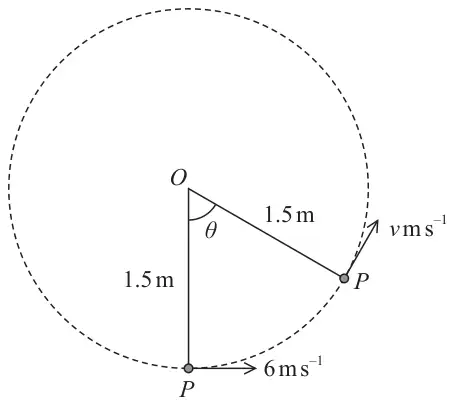
A particle \(P\) of mass 0.4 kg is attached to one end of a light inextensible string of length 1.5 m. The other end of the string is attached to a fixed point \(O\). The particle is at rest vertically below \(O\) with the string taut.
The particle is then projected horizontally with speed \(6\ \text{m s}^{-1}\)
When the string has turned through an angle \(\theta\), the string is still taut and the speed of \(P\) is \(v\ \text{m s}^{-1}\), as shown in Figure 8.
(a) Show that when \(v = 3\sqrt{2}\), the tension in the string is 6.4 N. (7)
(b) Find the magnitude of the acceleration of \(P\) when \(v = 3\sqrt{2}\) (5)
SC: Candidates who use \(g = 9.8\) are eligible for all marks except the final A1 in each of parts (a) and (b). If they only use \(g = 9.8\) in one part, then this penalty only applies to that part. In part (b) candidates are also eligible for all marks except the final A1 if they use the given answer of 6.4 from (a) along with \(g = 9.8\) in their other work.
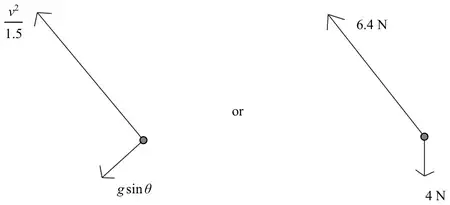
M1: Need all terms. Dimensionally correct. Condone sign errors and sin/cos confusion
A1: Unsimplified equation with at most one error
A1: Correct unsimplified equation. Accept with \(g\) or 10
M1: Need all terms. Dimensionally correct. Condone sign errors and sin/cos confusion
A1: Correct unsimplified equation. Accept with \(g\) or 10
M1: Complete strategy to find \(T\) e.g. use conservation of energy, circular motion and substitute value for \(v\) to form sufficient equations to find \(T\)
A1*: Obtain given answer from correct working. N.B. \(g = 9.8\) gives \(T = 6.32\) (but scores A0)
SC: Candidates who use \(g = 9.8\) are eligible for all marks except the final A1 in each of parts (a) and (b). If they only use \(g = 9.8\) in one part, then this penalty only applies to that part. In part (b) candidates are also eligible for all marks except the final A1 if they use the given answer of 6.4 from (a) along with \(g = 9.8\) in their other work.
B1: Correct only. Must be seen or used in part (b). Award for \(\sin\theta = \dfrac{\sqrt{21}}{5}\) N.B. \(g = 9.8\) gives \(\cos\theta = \dfrac{19}{49}\ (= 0.38775...)\), \(\sin\theta = \dfrac{2\sqrt{510}}{49}\ (= 0.92176...)\)
B1: One component of acceleration or force correct (unsimplified)
B1: Both components of acceleration or force correct (unsimplified) N.B. \(g = 9.8\) gives components as 12 & 9.03 (velocity) or 6.32 and 3.92 (force)
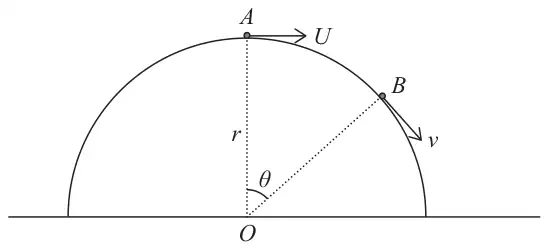
A smooth solid hemisphere has radius \(r\) and the centre of its plane face is \(O\). The hemisphere is fixed with its plane face in contact with horizontal ground, as shown in Figure 6. A small stone is at the point \(A\), the highest point on the surface of the hemisphere. The stone is projected horizontally from \(A\) with speed \(U\). The stone is still in contact with the hemisphere at the point \(B\), where \(OB\) makes an angle \(\theta\) with the upward vertical. The speed of the stone at the instant it reaches \(B\) is \(v\).
The stone is modelled as a particle \(P\) and air resistance is modelled as being negligible.
(a) Use the model to find \(v^2\) in terms of \(U\), \(r\), \(g\) and \(\theta\) (3)
When \(P\) leaves the surface of the hemisphere, the speed of \(P\) is \(W\).
Given that \(U = \sqrt{\dfrac{2rg}{3}}\)
(b) show that \(W^2 = \dfrac{8}{9}rg\) (5)
After leaving the surface of the hemisphere, \(P\) moves freely under gravity until it hits the ground.
(c) Find the speed of \(P\) as it hits the ground, giving your answer in terms of \(r\) and \(g\). (3)
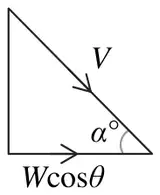
At the instant when \(P\) hits the ground it is travelling at \(\alpha^\circ\) to the horizontal.
M1: Equation for conservation of mechanical energy. All terms required and no extras; dimensionally correct. Condone sine / cosine confusion and sign errors.
M1: Equation for circular motion. Dimensionally correct. Condone sine / cosine confusion and sign errors. Condone if \(R = 0\) seen or implied at this stage.
A1: Correct unsimplified equation
M1: Use \(R = 0\) in a relevant equation to obtain equation in \(r\), \(g\) and \(\cos\theta\) or \(W\)
A1: Any correct equation in \(r\), \(g\) and \(\cos\theta\) or \(r\), \(g\) and \(W\) E.g. \(W^2 = \dfrac{2gr}{3} + 2gr - 2W^2\)
A1*: Obtain given result from correct exact working
Mark scheme (c)
Scheme
Marks
AO
Energy equation
M1
3.1b
From \(B\): \(\dfrac{1}{2}mV^2 = \dfrac{1}{2}mW^2 + mgr\cos\theta\) or from \(A\): \(\dfrac{1}{2}mV^2 = \dfrac{1}{2}mU^2 + mgr\)
M1:Complete method to find the speed, e.g. by using conservation of energy or projectile motion. All terms required and no extras; dimensionally correct.
M1: Complete method to form a trig ratio for \(\alpha\)
A1ft: Correct use of their values to obtain a ratio for \(\alpha\). Ft their \(V\). \(\left(\sin\alpha = \dfrac{\sqrt{537}}{27} = 0.858, \quad \tan\alpha = \dfrac{\sqrt{179}}{8} = 1.67\right)\)
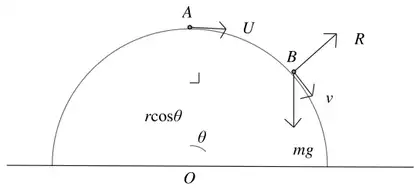
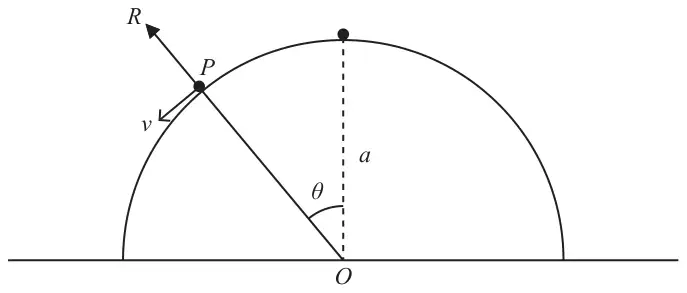
A smooth hemisphere of radius \(a\) is fixed on a horizontal surface with its plane face in contact with the surface. The centre of the plane face of the hemisphere is \(O\).
A particle \(P\) of mass \(M\) is disturbed from rest at the highest point of the hemisphere.
When \(P\) is still on the surface of the hemisphere and the radius from \(O\) to \(P\) is at an angle \(\theta\) to the vertical,
the speed of \(P\) is \(v\)
the normal reaction between the hemisphere and the particle is \(R\), as shown in Figure 2.
(a) Show that \(R = Mg(3\cos\theta - 2)\) (6)
(b) Find, in terms of \(a\) and \(g\), the speed of the particle at the instant when the particle leaves the surface of the hemisphere. (3)
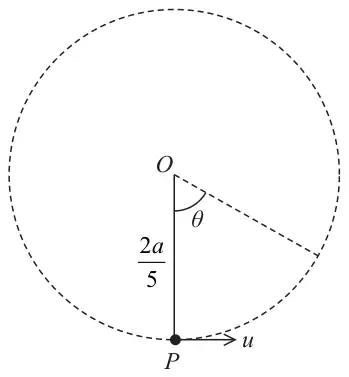
A package \(P\) of mass \(m\) is attached to one end of a string of length \(\dfrac{2a}{5}\). The other end of the string is attached to a fixed point \(O\). The package hangs at rest vertically below \(O\) with the string taut and is then projected horizontally with speed \(u\), as shown in Figure 5.
When \(OP\) has turned through an angle \(\theta\) and the string is still taut, the tension in the string is \(T\)
The package is modelled as a particle and the string as being light and inextensible.
(a) Show that \(T = 3mg\cos\theta - 2mg + \dfrac{5mu^2}{2a}\) (6)
Given that \(P\) moves in a complete vertical circle with centre \(O\)
(b) find, in terms of \(a\) and \(g\), the minimum possible value of \(u\) (2)
Given that \(u = 2\sqrt{ag}\)
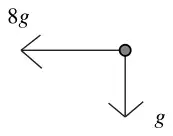
(c) find, in terms of \(g\), the magnitude of the acceleration of \(P\) at the instant when \(OP\) is horizontal. (3)
(d) Apart from including air resistance, suggest one way in which the model could be refined to make it more realistic. (1)
M1: Need all terms. Dimensionally correct. Condone sign errors and sin/cos confusion Allow with \(\dfrac{2a}{5}\cos\theta\) in place of \(\dfrac{2a}{5}(1 - \cos\theta)\)
A1: Correct unsimplified equation
M1: Need all terms. Dimensionally correct. Condone sign errors and sin/cos confusion
A1: Correct unsimplified equation
M1: Complete method, e.g. using conservation of energy and the circular motion, to form sufficient equations to obtain an expression without \(v\) A complete method requires the two preceding M marks.
\(\theta = \dfrac{\pi}{2},\ u = 2\sqrt{ag} \ \Rightarrow\ T = -2mg + \dfrac{5m}{2a}\times 4ag\)
B1
1.1b
Magnitude of acceleration \(= g\sqrt{64 + 1}\)
M1
2.1
\(= \sqrt{65}g\)
A1
1.1b
(3)
Notes
B1: Correct \(T\) or \(v^2\) seen or implied
M1: Use of Pythagoras with their horizontal component of acceleration
A1: Correct only, or \(8.1g\) \((8.062\ldots g)\) or better
Mark scheme (d)
Scheme
Marks
AO
Consider the uniformity / dimensions of the package String might be extensible. include the weight of the string
B1
3.5c
(1)
(12 marks)
Notes
B1: Any valid suggestion relating to the model. Allow negatives of statements within the model e.g. not model the package as a particle. B0 if multiple suggestions including one incorrect. B0 for accuracy of \(g\) as this is not part of the description of the model.
5. A light inextensible string of length \(a\) has one end attached to a fixed point \(O\). The other end of the string is attached to a small stone of mass \(m\). The stone is held with the string taut and horizontal. The stone is then projected vertically upwards with speed \(U\).
The stone is modelled as a particle and air resistance is modelled as being negligible.
Assuming that the string does not break, use the model to
(a) find the least value of \(U\) so that the stone will move in complete vertical circles. (6)
The string will break if the tension in it is equal to \(\dfrac{11mg}{2}\)
Given that \(U = 2\sqrt{ag}\), use the model to
(b) find the total angle that the string has turned through, from when the stone is projected vertically upwards, to when the string breaks, (6)
(c) find the magnitude of the acceleration of the stone at the instant just before the string breaks. (4)
Mark scheme (a)
Scheme
Marks
AO
Equation of motion along the string at the top of the circle
M1
3.1b
\(T + mg = \dfrac{mv^2}{a}\)
A1
1.1b
Conservation of energy
M1
3.1b
\(\dfrac{1}{2}mU^2 - \dfrac{1}{2}mv^2 = mga\)
A1
1.1b
Overall strategy to solve these equations for \(T\) and use \(T = 0\)
M1
3.1b
\(U = \sqrt{3ga}\)
A1
1.1b
(6)
Notes
M1: Correct number of terms
A1: Correct equation
M1: All terms needed and dimensionally correct
A1: Correct equation
M1: Solve for \(T\) and use \(T = 0\) (allow \(T \geqslant 0\))
A1: cao
Mark scheme (b)
Scheme
Marks
AO
Equation of motion along the string at instant string breaks
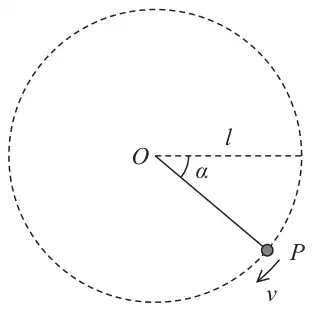
A particle \(P\) of mass \(m\) is attached to one end of a light inextensible string of length \(l\). The other end of the string is attached to a fixed point \(O\). The particle is held with the string taut and \(OP\) horizontal. The particle is then projected vertically downwards with speed \(u\), where \(u^2 = \dfrac{9}{5}gl\). When \(OP\) has turned through an angle \(\alpha\) and the string is still taut, the speed of \(P\) is \(v\), as shown in Figure 5. At this instant the tension in the string is \(T\).
(a) Show that \(T = 3mg\sin\alpha + \dfrac{9}{5}mg\) (6)
(b) Find, in terms of \(g\) and \(l\), the speed of \(P\) at the instant when the string goes slack. (3)
(c) Find, in terms of \(l\), the greatest vertical height reached by \(P\) above the level of \(O\). (4)
M1: Must include all terms. Condone sign errors and sin/cos confusion
A1: Correct unsimplified equation
M1: Must include all terms. Condone sign errors and sin/cos confusion
A1: Correct unsimplified equation
M1: Complete strategy to form an expression for \(T\) in terms of \(\alpha\) e.g. by using conservation of energy and the circular motion to form sufficient equations to obtain an equation in \(T\) only.
A1*: Obtain given answer from correct working
Mark scheme (b)
Scheme
Marks
AO
String slack \(\Rightarrow T = 0 \Rightarrow \sin\alpha = -\dfrac{3}{5}\)
B1
3.1a
Use energy equation to find \(v\):
M1
1.1b
\(v^2 = \dfrac{9gl}{5} - \dfrac{3}{5}\times 2gl,\quad v = \sqrt{\dfrac{3gl}{5}}\)
A1
1.1b
(3)
Notes
B1: Correct deduction
M1: Substitute value to find \(v^2\)
A1: Correct only
Mark scheme (c)
Scheme
Marks
AO
Initial vertical component of speed \(= \dfrac{4}{5}\times\sqrt{\dfrac{3gl}{5}}\)
B1
1.1b
Use of suvat: \(0 = u^2 - 2gh = \dfrac{16}{25}\times\dfrac{3gl}{5} - 2gh\)
M1
3.1a
\(h = \dfrac{24l}{125}\)
A1
1.1b
Total height above \(O = \dfrac{3l}{5} + \dfrac{24l}{125} = \dfrac{99l}{125}\)
A1
2.2a
(4)
(13 marks)
Notes
B1: Correct vertical component of velocity when string goes slack.
M1: Use of \(v^2 = u^2 + 2as\) or alternative complete method to find the additional height.
A1: Additional height correct
A1: Total height correct
Alternative (c)
Scheme
Marks
AO
Initial horizontal component of speed \(= \dfrac{3}{5}\times\sqrt{\dfrac{3gl}{5}}\)
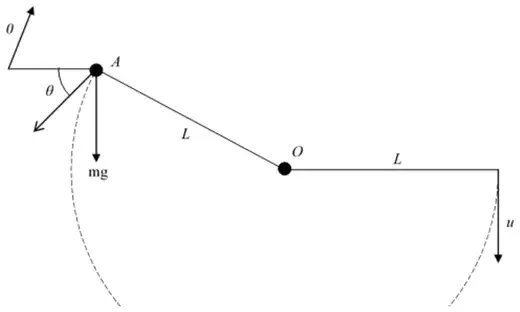
7. A particle, \(P\), of mass \(m\) is attached to one end of a light rod of length \(L\). The other end of the rod is attached to a fixed point \(O\) so that the rod is free to rotate in a vertical plane about \(O\). The particle is held with the rod horizontal and is then projected vertically downwards with speed \(u\). The particle first comes to instantaneous rest at the point \(A\).
(a) Explain why the acceleration of \(P\) at \(A\) is perpendicular to \(OA\). (1)
At the instant when \(P\) is at the point \(A\) the acceleration of \(P\) is in a direction making an angle \(\theta\) with the horizontal. Given that \(u^2 = \dfrac{2gL}{3}\),
(b) find
(i) the magnitude of the acceleration of \(P\) at the point \(A\),
(ii) the size of \(\theta\). (6)
(c) Find, in terms of \(m\) and \(g\), the magnitude of the tension in the rod at the instant when \(P\) is at its lowest point. (5)
Mark scheme (a)
Scheme
Marks
AO
\(v = 0 \Rightarrow \dfrac{v^2}{L} = 0 \Rightarrow\) no acceleration towards \(O\) \(\Rightarrow\) acceleration is perpendicular to \(OA\)