
M3 June 2013 Q1
1.
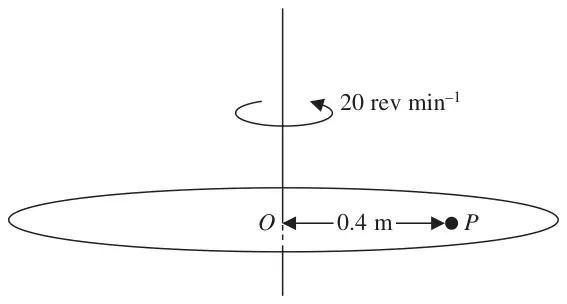
A rough disc is rotating in a horizontal plane with constant angular speed 20 revolutions per minute about a fixed vertical axis through its centre \(O\). A particle \(P\) rests on the disc at a distance 0.4 m from \(O\), as shown in Figure 1. The coefficient of friction between \(P\) and the disc is \(\mu\). The particle \(P\) is on the point of slipping.
Find the value of \(\mu\). (6)
| Scheme | Marks |
|---|---|
| R\((\uparrow)\) \(R = mg\) | |
| \(F = \mu mg\) | B1 |
| 20 revs per min \(= \dfrac{20}{60} \times 2\pi\) rad s\(^{-1}\) \(\left(= \dfrac{2}{3}\pi\ \text{rad s}^{-1}\right)\) | M1A1 |
| R\((\rightarrow)\) \(\mu mg = m \times 0.4 \times \left(\dfrac{2}{3}\pi\right)^2\) | M1A1ft |
| \(\mu = \dfrac{0.4 \times 4\pi^2}{9g}\) | |
| \(\mu = 0.18\) or 0.179 | A1 |
| (6 marks) |
Notes
B1 for resolving vertically and using \(F = \mu R\) to obtain \(F = \mu mg\). This may not be seen explicitly, but give B1 when seen used in an equation.
M1 for attempting to change revs per minute to rad s\(^{-1}\), must see \((2)\pi\). (Can use 60 or 60\(^2\))
A1 for \(\dfrac{20}{60} \times 2\pi\) (rad s\(^{-1}\)) oe
M1 for NL2 horizontally along the radius - acceleration in either form for this mark, \(F\) or \(\mu mg\) or \(\mu m\) all allowed. \(r\) to be 0.4 now or later. This is not dependent on the previous M mark.
A1ft for \(\mu mg = m \times 0.4 \times \left(\dfrac{2}{3}\pi\right)^2\) follow through on their \(\omega\)
A1cso for \(\mu = 0.18\) or 0.179, must be 2 or 3 sf.
NB: Use of \(\leqslant\): is allowed, provided used correctly, until the final statement, which must be \(\mu = \ldots\)