
M3 January 2008 Q3
3.
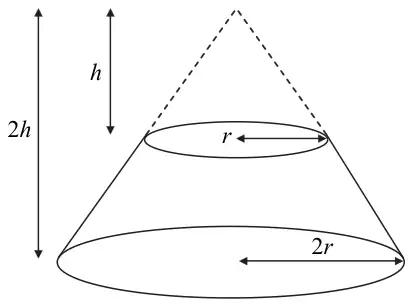
A uniform solid \(S\) is formed by taking a uniform solid right circular cone, of base radius \(2r\) and height \(2h\), and removing the cone, with base radius \(r\) and height \(h\), which has the same vertex as the original cone, as shown in Figure 1.
The solid \(S\) lies with its larger plane face on a rough table which is inclined at an angle \(\theta^\circ\) to the horizontal. The table is sufficiently rough to prevent \(S\) from slipping. Given that \(h = 2r\),
| Scheme | Marks | ||||||||||||
|---|---|---|---|---|---|---|---|---|---|---|---|---|---|
| B1 B1, B1 | ||||||||||||
| \(\tfrac{8}{3}\pi r^2h.\tfrac{1}{2}h - \tfrac{1}{3}\pi r^2h.\tfrac{5}{4}h = \tfrac{7}{3}\pi r^2h.\bar{x}\) or equivalent | M1 | ||||||||||||
| \(\rightarrow \bar{x} = \tfrac{11}{28}h\) * | A1 | ||||||||||||
| (5) |
Notes
Centres of mass may be measured from another point (e.g. centre of small circle, or vertex). The Method mark will then require a complete method (Moments and subtraction) to give required value for \(\bar{x}\)). However B marks can be awarded for correct values if the candidate makes the working clear.
| Scheme | Marks |
|---|---|
| \(\tan\theta = \dfrac{2r}{\bar{x}} = \dfrac{2r}{\frac{11}{28}h},\ = \dfrac{2r}{\frac{11}{14}r} = \dfrac{28}{11}\) | M1, A1 |
| \(\theta \approx 68.6^\circ\) or 1.20 radians | A1 |
| (3) | |
| (8 marks) |
Notes
(Special case – obtains complement by using \(\tan\theta = \dfrac{\bar{x}}{2r}\) giving 21.4\(^\circ\) or .374 radians M1A0A0)
(Corrected from the printed mark scheme: the special case is printed as \(\tan\theta = \dfrac{2r}{\bar{x}}\).)