
M2 June 2014 Q3
3.
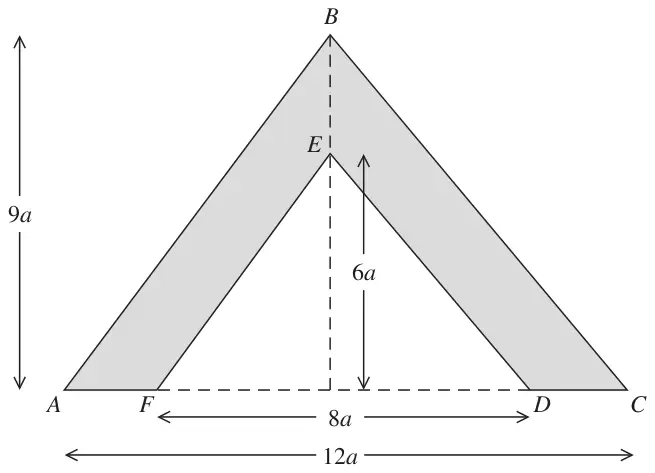
The uniform lamina \(ABCDEF\), shown shaded in Figure 1, is symmetrical about the line through \(B\) and \(E\). It is formed by removing the isosceles triangle \(FED\), of height \(6a\) and base \(8a\), from the isosceles triangle \(ABC\) of height \(9a\) and base \(12a\).
The lamina is freely suspended from \(A\) and hangs in equilibrium.
| Scheme | Marks |
|---|---|
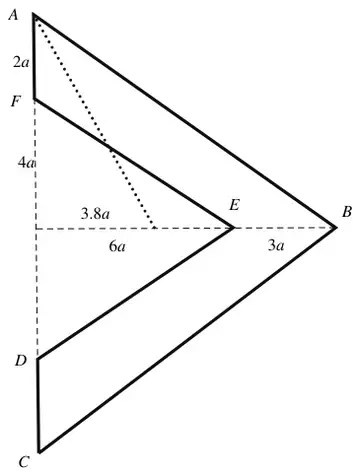 | |
| Ratio of areas 54 : 24 : 30 (or equivalent) | B1 |
| Distance of c of m from \(AC\) \(3a\), \(2a\) | B1 |
| The two B marks can be implied by a correct moments equation | |
| Moments about \(AC\): \(30d = 3a \times 54 - 2a \times 24\ (= 114a)\) | M1 A1 |
| \(d = \dfrac{114a}{30} = 3.8a\) | A1 |
| (5) |
Notes
M1 All terms need to be there. Must be subtracting. Allow with \(g\) as a common factor. Allow use of an axis parallel to \(AC\) Allow in vector form.
A1 Correct unsimplified equation (allow in vector form)
A1 Accept any equivalent form
NB If “\(a\)” does not appear in the solution at all, mark the work as a misread. If “\(a\)” appears and disappears then mark as given in the scheme.
| Scheme | Marks |
|---|---|
| Correct triangle and use of \(\tan^{-1}\) or equivalent | M1 |
| \(\tan^{-1}\left(\dfrac{3.8a}{6a}\right),\ \tan^{-1}\left(\dfrac{6a}{3.8a}\right),\ 32.3\ldots\) or \(57.65\ldots\) | A1 |
| Required angle \(= \tan^{-1}\left(\dfrac{9a}{6a}\right) - \tan^{-1}\left(\dfrac{3.8a}{6a}\right) = 23.96\ldots = 24^\circ\) | DM1 A1 |
| (4) | |
| (9 marks) |
Notes
M1 Find a relevant angle using their \(d\). Condone ratio the wrong way up. Allow \(\tan^{-1}\left(\dfrac{\text{their } d}{\text{their } \bar{x}}\right)\)
DM1 Correct method for the required angle. Dependent on the previous M mark.
A1 Only. The Q asks for answers to the nearest degree.
alt2
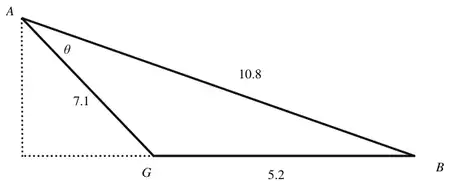 | M1 A1 |
| \(\cos\theta = \dfrac{10.8^2 + 7.1^2 - 5.2^2}{2 \times 10.8 \times 7.1}\) | DM1 |
| \(\theta = 24^\circ\) | A1 |
M1 Identify the correct triangle and find the lengths of the sides
A1 All correct (accept lengths as unsimplified calculations using Pythagoras)
DM1 Use trigonometry to find \(\theta\)