
M2 June 2012 Q7
7.
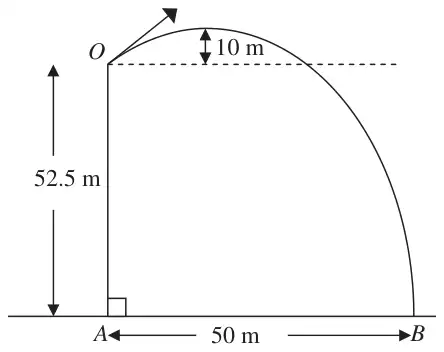
A small stone is projected from a point \(O\) at the top of a vertical cliff \(OA\). The point \(O\) is 52.5 m above the sea. The stone rises to a maximum height of 10 m above the level of \(O\) before hitting the sea at the point \(B\), where \(AB = 50\) m, as shown in Figure 4. The stone is modelled as a particle moving freely under gravity.
| Scheme | Marks |
|---|---|
| \(0^2 = u_V^{\,2} - 2 \times 9.8 \times 10\) | M1 A1 |
| \(u_V = 14\ \ *\) | A1 |
| (3) |
Notes
M1 Complete method using suvat to form an equation in \(u_v\).
A1 Correct equation e.g. \(0 = u^2 - 20g\)
A1 *Answer given* requires equation and working, including 196, seen.
OR
| conservation of energy: | M1 |
| \(\dfrac{1}{2}m\left(u_h^{\,2} + u_v^{\,2}\right) = mg \times 10 + \dfrac{1}{2}mu_h^{\,2},\ \ \dfrac{1}{2}u_v^{\,2} = 98\) | A1 |
| \(u_V = 14\ \ *\) | A1 |
M1 Initial KE = gain in GPE + final KE
A1 Correct equation
A1 *Answer given*
| Scheme | Marks |
|---|---|
| \((\uparrow),\ -52.5 = 14t - \tfrac{1}{2}gt^2\) | M1 A1 A1 |
| \(49t^2 - 140t - 525 = 0\) | DM1 |
| \((t - 5)(49t + 105) = 0\ \ \ \ t = 5\) | A1 |
| \((\rightarrow),\ \ 50 = 5u_H\) | M1 |
| \(u_H = 10\) | A1 |
| \(u = \sqrt{10^2 + 14^2}\) | M1 |
| \(= \sqrt{296}\); 17.2 m s\(^{-1}\) | A1 |
| (9) |
Notes
M1 Use the vertical distance travelled to find the total time taken.
A1 At most one error
A1 Correct equation
DM1 Solve for \(t\). Dependent on the preceding M mark
A1 only
M1 Use their time of flight to form an equation in \(u_H\)
A1 only
M1 Use of Pythagoras with two non-zero components, or solution of a pair of simultaneous equations in \(u\) and \(\alpha\).
A1 17.2 or 17 (method involves use of g = 9.8 so an exact surd answer is not acceptable)
OR
| First 3 marks for the quadratic as above. | |
| \(50 = u\cos\alpha t\) or \(50 = u_H t\) | M1 |
| \(49\left(\dfrac{50}{u_H}\right)^2 - 140\left(\dfrac{50}{u_H}\right) - 525 = 0\) \(525(u_H)^2 + 7000(u_H) - 122500 = 0\) | A1 |
| Solve for \(u_H\) | DM1 |
| \(u_H = 10\) etc. | A1 |
M1 Used in their quadratic
A1 Correct quadratic in \(u_H\)
DM1 Dependent on the M mark for setting up the initial quadratic equation in t.
A1 only
Complete as above.
(Corrected from the printed mark scheme: the coefficient of \((u_H)\) in the quadratic is printed as 140; multiplying through by \((u_H)^2\) gives 7000.)
| Scheme | Marks |
|---|---|
| \(\tan OBA = \dfrac{52.5}{50} = 1.05\) | B1 |
| \(v_V = 1.05 \times 10 = 10.5\) | M1 |
| \((\uparrow),\ \ -10.5 = 14 - gt\) | DM1 A1 |
| \(t = 2.5\) | A1 |
| (5) | |
| (17 marks) |
Notes
B1 Correct direction o.e. (accept reciprocal)
M1 Use trig. with their \(u_H\) and correct interpretation of direction to find the vertical component of speed. Working with distances is M0. (condone \(10 \div 1.05\))
DM1 Use suvat to form an equation in t. Dependent on the preceding M.
A1 Correct equation for their \(u_H\). For incorrect direction give A0 here.
A1 only