
M2 June 2007 Q4
4.
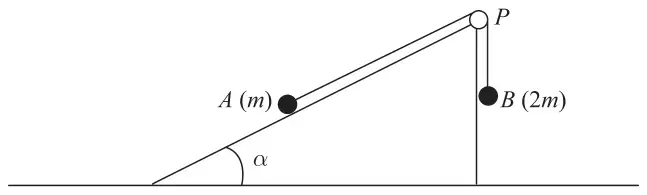
Two particles \(A\) and \(B\), of mass \(m\) and \(2m\) respectively, are attached to the ends of a light inextensible string. The particle \(A\) lies on a rough plane inclined at an angle \(\alpha\) to the horizontal, where \(\tan\alpha = \dfrac{3}{4}\). The string passes over a small light smooth pulley \(P\) fixed at the top of the plane. The particle \(B\) hangs freely below \(P\), as shown in Figure 2. The particles are released from rest with the string taut and the section of the string from \(A\) to \(P\) parallel to a line of greatest slope of the plane. The coefficient of friction between \(A\) and the plane is \(\dfrac{5}{8}\). When each particle has moved a distance \(h\), \(B\) has not reached the ground and \(A\) has not reached \(P\).
When each particle has moved a distance \(h\), they are moving with speed \(v\). Using the work-energy principle,
| Scheme | Marks |
|---|---|
| PE lost \(= 2mgh - mgh\sin\alpha\ \ (= 7mgh/5)\) | M1 A1 |
| (2) |
Notes
M1 Two term expression for PE lost. Condone sign errors and sin/cos confusion, but must be vertical distance moved for A
A1 Both terms correct, \(\sin\alpha\) correct, but need not be simplified. Allow \(13.72mh\). Unambiguous statement.
| Scheme | Marks |
|---|---|
| Normal reaction \(R = mg\cos\alpha\ \ (= 4mg/5)\) | B1 |
| Work-energy: \(\ \dfrac{1}{2}mv^2 + \dfrac{1}{2} \cdot 2mv^2 = \dfrac{7mgh}{5} - \dfrac{5}{8} \cdot \dfrac{4mg}{5} \cdot h\) | M1 A2,1,0 |
| \(\Rightarrow \dfrac{3}{2}mv^2 = \dfrac{9mgh}{10} \ \Rightarrow\ v^2 = \dfrac{3}{5}gh\) | A1 |
| (5) | |
| (7 marks) |
Notes
B1 Normal reaction between A and the plane. Allow when seen in (b) provided it is clearly the normal reaction. Must use \(\cos\alpha\) but need not be substituted.
M1 (NB QUESTION SPECIFIES WORK & ENERGY) substitute into equation of the form PE lost = Work done against friction plus KE gained. Condone sign errors. They must include KE of both particles.
A1A1 All three elements correct (including signs)
A1A0 Two elements correct, but follow their GPE and \(\mu \times\) their \(R \times h\).
A1 \(V^2\) correct (NB \(kgh\) specified in the Q)