
M2 January 2011 Q5
5.
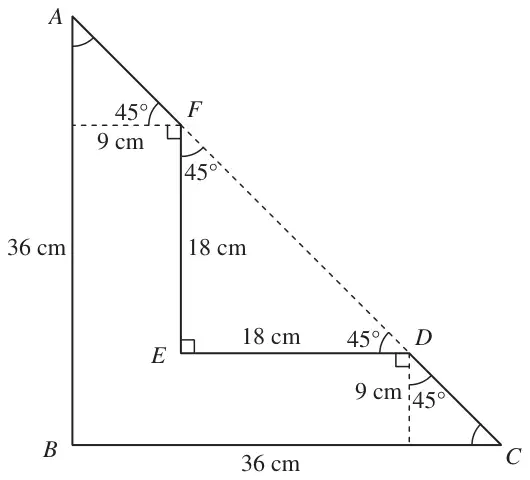
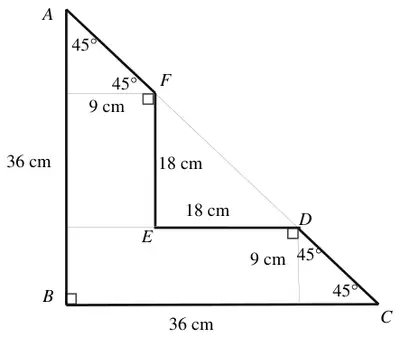
The uniform L-shaped lamina \(ABCDEF\), shown in Figure 2, has sides \(AB\) and \(FE\) parallel, and sides \(BC\) and \(ED\) parallel. The pairs of parallel sides are 9 cm apart. The points \(A\), \(F\), \(D\) and \(C\) lie on a straight line.
\(AB = BC = 36\) cm, \(FE = ED = 18\) cm. \(\angle ABC = \angle FED = 90^\circ\), and
\(\angle BCD = \angle EDF = \angle EFD = \angle BAC = 45^\circ\).
(a) Find the distance of the centre of mass of the lamina from
(i) side \(AB\),
(ii) side \(BC\). (7)
The lamina is freely suspended from \(A\) and hangs in equilibrium.
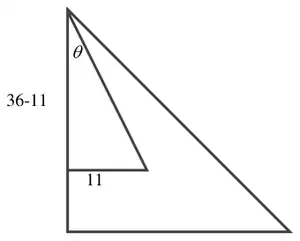
(b) Find, to the nearest degree, the size of the angle between \(AB\) and the vertical. (3)
| Scheme | Marks | |||||||||||||||
|---|---|---|---|---|---|---|---|---|---|---|---|---|---|---|---|---|
| Divide the shape into usable areas, e.g.: | ||||||||||||||||
| ||||||||||||||||
| Mass ratios | B1 | |||||||||||||||
| Centres of mass | B1 | |||||||||||||||
| Take moments about AB: | M1 | |||||||||||||||
| \(6 \times 13.5 + 1 \times 30 + 4 \times 4.5 + 1 \times 3 = 132 = 12\bar{x}\), | A(2,1,0) | |||||||||||||||
| \(\bar{x} = 11\ (\text{cm})\quad\) solve for \(x\) (or \(y\)) co-ord | A1 | |||||||||||||||
| \(\bar{y} = 11\ (\text{cm})\quad\) using the symmetry | B1ft | |||||||||||||||
| (7) |
Alternative
| ||||||||||
| \(\dfrac{1}{2} \times 36 \times 36 \times 12 - \dfrac{1}{2} \times 18 \times 18 \times 15 = \dfrac{1}{2}(36 \times 36 - 18 \times 18)\bar{x}\) etc. |
| Scheme | Marks |
|---|---|
| \(\tan\theta = \dfrac{\bar{x}}{36 - \bar{y}}\) | M1 |
| \(\tan\theta = \dfrac{11}{25} = 0.44\) | A1ft |
| \(\theta = 24^\circ\) | A1 |
| (3) | |
| (10 marks) |