
M1 June 2013 Q6
6. A beam \(AB\) has length 15 m. The beam rests horizontally in equilibrium on two smooth supports at the points \(P\) and \(Q\), where \(AP = 2\) m and \(QB = 3\) m. When a child of mass 50 kg stands on the beam at \(A\), the beam remains in equilibrium and is on the point of tilting about \(P\). When the same child of mass 50 kg stands on the beam at \(B\), the beam remains in equilibrium and is on the point of tilting about \(Q\). The child is modelled as a particle and the beam is modelled as a non-uniform rod.
When the child stands at the point \(X\) on the beam, it remains horizontal and in equilibrium. Given that the reactions at the two supports are equal in magnitude,
| Scheme | Marks |
|---|---|
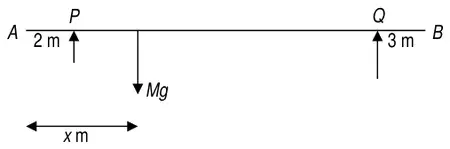 | |
| M\((P)\), \(50g \times 2 = Mg \times (x - 2)\) | M1 A1 |
| M\((Q)\), \(50g \times 3 = Mg \times (12 - x)\) | M1 A1 |
| (i) \(M = 25\) (kg) | DM1 A1 |
| (ii) \(x = 6\) (m) | DM1 A1 |
| (8) |
Notes
First M1 for moments about \(P\) equation with usual rules (or moments about a different point AND vertical resolution and \(R\) then eliminated) (M0 if non-zero reaction at \(Q\))
Second M1 for moments about \(Q\) equation with usual rules (or moments about a different point AND vertical resolution) (M0 if non-zero reaction at \(P\))
Second A1 for a correct equation in \(M\) and same unknown.
Third M1, dependent on first and second M marks, for solving for \(M\)
Third A1 for 25 (kg)
Fourth M1, dependent on first and second M marks, for solving for \(x\)
Fourth A1 for 6 (m)
N.B. No marks available if rod is assumed to be uniform but can score max 5/6 in part (b), provided they have found values for \(M\) and \(x\) to f.t. on.
If they have just invented values for \(M\) and \(x\) in part (a), they can score the M marks in part (b) but not the A marks.
| Scheme | Marks |
|---|---|
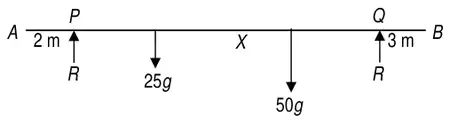 | |
| \((\uparrow)\ R + R = 25g + 50g\) | M1 A1 ft |
| M\((A)\), \(2R + 12R = 25g \times 6 + 50g \times AX\) | M1 A1 ft |
| \(AX = 7.5\) (m) | DM1 A1 |
| (6) | |
| (14 marks) |
Notes
First M1 for vertical resolution or a moments equation, with usual rules.
First A1 ft on their \(M\) and \(x\) from part (a), for a correct equation. (must have equal reactions in vertical resolution to earn this mark)
Second M1 for a moments equation with usual rules.
Second A1 ft on their \(M\) and \(x\) from part (a), for a correct equation in \(R\) and same unknown length.
Third M1, dependent on first and second M marks, for solving for \(AX\) (not their unknown length) with \(AX \leqslant 15\)
Third A1 for \(AX = 7.5\) (m)
N.B. If a single equation is used (see below), equating the sum of the moments of the child and the weight about \(P\) to the sum of the moments of the child and the weight about \(Q\), this can score M2 A2 ft on their \(M\) and \(x\) from part (a), provided the equation is in one unknown. Any method error, loses both M marks.
e.g. \(25g.4 + 50g(x - 2) = 25g.6 + 50g(12 - x)\) oe.