
4400 Higher November 2006 Paper 3 Q9
9 \(ABC\) is a triangle.
\(AB = AC = 13\) cm.
\(BC = 10\) cm.
\(M\) is the midpoint of \(BC\).
Angle \(AMC = 90^\circ\).
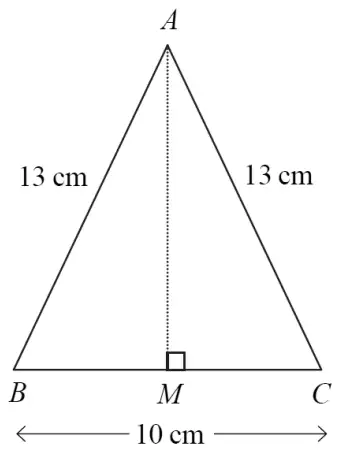
Diagram NOT accurately drawn
(a) Work out the length of \(AM\). (4)
(b) A solid has five faces.
Four of the faces are triangles identical to triangle \(ABC\).
The base of the solid is a square of side 10 cm.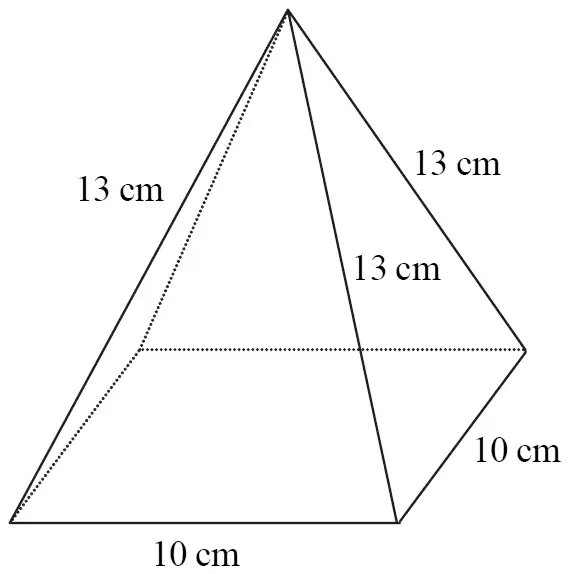
Four of the faces are triangles identical to triangle \(ABC\).
The base of the solid is a square of side 10 cm.
Diagram NOT accurately drawn
Calculate the total surface area of this solid. (4)| Scheme | Marks |
|---|---|
| \(BM = 5\) seen or implied | B1 |
| \(13^2 - 5^2\) or 144 | M1 |
| \(\sqrt{13^2 - 5^2}\) | M1 |
| 12 | A1 |
| (4) |
Notes
M1: for squaring and subtracting
Accept \(13^2 - 10^2\) or 69
M1: for \(\sqrt{13^2 - 5^2}\) only
A1: cao
| Scheme | Marks |
|---|---|
| \(\frac{1}{2} \times 10 \times \text{“}12\text{”}\) | M1 |
| × 4 | M1 |
| 10 × 10 or 100 | M1 |
| 340 | A1 |
| (4) | |
| (8 marks) |
Notes
M1: for \(\frac{1}{2} \times 10 \times\) their (a)
M1: dep on first M1
M1: indep
A1: ft from “12”