
4400 Higher November 2005 Paper 4 Q11
11 A right-angled triangle has sides of length \(x\) cm, \((x + 2)\) cm and \((x + 3)\) cm.
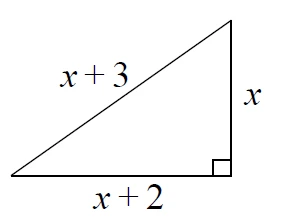
(a) Use Pythagoras’ theorem to write down an equation in \(x\). (1)
(b) Show that your equation simplifies to \(x^2 - 2x - 5 = 0\) (2)
(c) By solving the equation \(x^2 - 2x - 5 = 0\), find the length of each side of the triangle.
Give your answers correct to one decimal place. (3)
Give your answers correct to one decimal place. (3)
| Scheme | Marks |
|---|---|
| \(x^2 + (x + 2)^2 = (x + 3)^2\) | B1 |
| (1) |
Notes
CHECK: the source has no mark scheme for this question (the slide repeats the scheme for November 2005 Paper 3 Q14). This is a suggested scheme, not Edexcel’s.
| Scheme | Marks |
|---|---|
| \(x^2 + x^2 + 4x + 4 = x^2 + 6x + 9\) | M1 |
| \(x^2 - 2x - 5 = 0\) | A1 |
| (2) |
Notes
M1: correct expansion of both brackets
A1: correct simplification with no errors
| Scheme | Marks |
|---|---|
| \(x = \dfrac{2 \pm \sqrt{(-2)^2 - 4 \times 1 \times (-5)}}{2}\) | M1 |
| \(x = 3.449\ldots\) (reject \(-1.449\ldots\)) | A1 |
| 3.4, 5.4, 6.4 | A1 |
| (3) | |
| (6 marks) |