
4400 Foundation June 2005 Paper 1 Q11
11 The diagram shows a kite \(ABCD\).
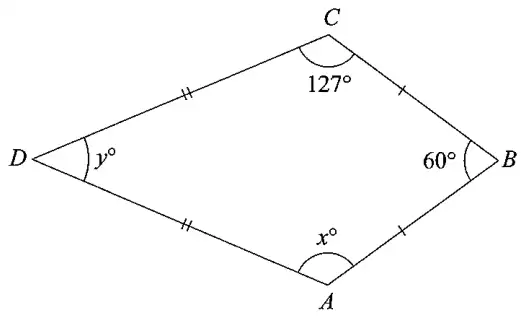
Diagram NOT accurately drawn
(a)
(i) Write down the value of \(x\).
(ii) Give a reason for your answer.
(2)(b)
(i) Work out the value of \(y\).
(ii) Give a reason for your answer.
(2)(c) Show that \(ABC\) is an equilateral triangle. (2)
| Scheme | Marks |
|---|---|
| (i) Answer: 127 | B1 |
| (ii) Answer: eg a kite has one pair of equal (opposite) angles, or the kite is symmetrical about \(BD\) | B1 |
| (2) |
Notes
No official mark scheme was available for this paper; this one was written by Westie's Workshop.
B1: cao
| Scheme | Marks |
|---|---|
| (i) 360 – (127 + 127 + 60) Answer: 46 | B1 |
| (ii) Answer: eg the angles of a quadrilateral add up to 360° | B1 |
| (2) |
Notes
No official mark scheme was available for this paper; this one was written by Westie's Workshop.
B1: ft from (a)(i)
| Scheme | Marks |
|---|---|
| \(BA = BC\) so triangle \(ABC\) is isosceles angle \(BAC\) = angle \(BCA\) = (180 – 60) ÷ 2 | M1 |
| = 60°, so all three angles are 60° (equilateral) | A1 |
| (2) | |
| (Total 6 marks) |
Notes
No official mark scheme was available for this paper; this one was written by Westie's Workshop.
M1: for using the equal sides (or base angles equal) and (180 – 60) ÷ 2
A1: for a complete reason