
FP3 June 2011 Q5
5. The curve \(C_1\) has equation \(y = 3\sinh 2x\), and the curve \(C_2\) has equation \(y = 13 - 3e^{2x}\).
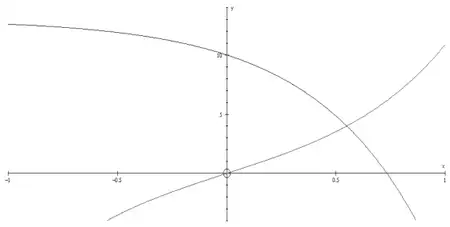
(a) Sketch the graph of the curves \(C_1\) and \(C_2\) on one set of axes, giving the equation of any asymptote and the coordinates of points where the curves cross the axes. (4)
(b) Solve the equation \(3\sinh 2x = 13 - 3e^{2x}\), giving your answer in the form \(\tfrac{1}{2}\ln k\), where \(k\) is an integer. (5)
| Scheme | Marks |
|---|---|
| Graph of \(y = 3\sinh 2x\) | B1 |
| Shape of \(-e^{2x}\) graph | B1 |
| Asymptote: \(y = 13\) | B1 |
| Value 10 on \(y\) axis and value 0.7 or \(\tfrac{1}{2}\ln\left(\tfrac{13}{3}\right)\) on \(x\) axis | B1 |
| (4) |
Notes
1B1 \(y = 3\sinh 2x\) first and third quadrant.
2B1 Shape of \(y = -e^{2x}\) correct intersects on positive axes.
3B1 Equation of asymptote, \(y = 13\), given. Penlise ‘extra’ asymptotes here
4B1 Intercepts correct both
| Scheme | Marks |
|---|---|
| Use definition \(\dfrac{3}{2}(e^{2x} - e^{-2x}) = 13 - 3e^{2x} \to 9e^{4x} - 26e^{2x} - 3 = 0\) to form quadratic | M1 A1 |
| \(\therefore e^{2x} = -\dfrac{1}{9}\) or 3 | DM1 A1 |
| \(\therefore x = \dfrac{1}{2}\ln(3)\) | B1 |
| (5) | |
| (9 marks) |
Notes
1M1 Getting a three terms quadratic in \(e^{2x}\)
1A1 Correct three term quadratic
2DM1 Solving for \(e^{2x}\)
2A1 CAO for \(e^{2x}\) condone omission of negative value.
B1 CAO one answer only