
FP2 June 2018 Q7
7.
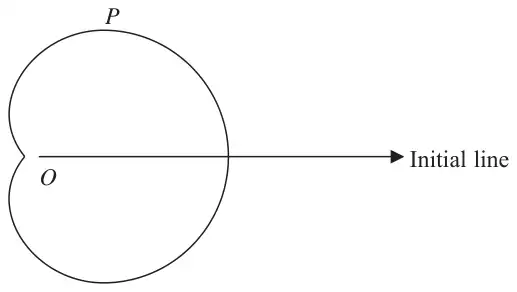
The curve \(C\) shown in Figure 1 has polar equation \[r = 2 + \sqrt{3}\cos\theta, \qquad 0 \leqslant \theta \lt 2\pi\]
The tangent to \(C\) at the point \(P\) is parallel to the initial line.
(a) Show that \(OP = \dfrac{1}{2}\left(3 + \sqrt{7}\right)\) (6)
(b) Find the exact area enclosed by the curve \(C\). (6)
| Scheme | Marks |
|---|---|
| \(r = 2 + \sqrt{3}\cos\theta\) | |
| Way 1 \(y = r\sin\theta = 2\sin\theta + \sqrt{3}\cos\theta\sin\theta\) Multiplies \(r\) by \(\sin\theta\) | B1 |
| \(\left(\dfrac{\mathrm{d}y}{\mathrm{d}\theta}\right) = 2\cos\theta + \sqrt{3}\cos^2\theta - \sqrt{3}\sin^2\theta\) M1 Differentiates using product rule A1 Correct derivative | M1A1 |
| \(2\cos\theta + \sqrt{3}\cos^2\theta - \sqrt{3}\left(1 - \cos^2\theta\right) = 0\) \(2\sqrt{3}\cos^2\theta + 2\cos\theta - \sqrt{3} = 0\) Use \(\sin^2\theta + \cos^2\theta = 1\) to form a 3TQ in \(\cos\theta\) and attempt to solve. Reach \(\cos\theta = \ldots\) | M1 |
| \(\cos\theta = \dfrac{-2 \pm \sqrt{28}}{4\sqrt{3}}\) or \(\dfrac{\sqrt{21} - \sqrt{3}}{6}\) oe Accept \(\pm\) or \(+\) Any exact equivalent – need not be simplified. | A1 |
| \(OP = r = 2 + \dfrac{-2 + \sqrt{28}}{4} = \dfrac{1}{2}\left(3 + \sqrt{7}\right)\) ** Must show substitution of correct, exact \(\cos\theta\) in \(r = 2 + \sqrt{3}\cos\theta\) | A1cso |
| (6) |
Notes
Way 2
| Scheme | Marks |
|---|---|
| \(y = r\sin\theta = (2 + \sqrt{3}\cos\theta)\sin\theta\) Leaves \(y\) as a product | B1 |
| \(\left(\dfrac{\mathrm{d}y}{\mathrm{d}\theta}\right) = (2 + \sqrt{3}\cos\theta)\cos\theta - \sqrt{3}\sin\theta\sin\theta\) M1 Differentiates using product rule A1 Correct derivative | M1A1 |
| \(2\cos\theta + \sqrt{3}\cos^2\theta - \sqrt{3}\left(1 - \cos^2\theta\right) = 0\) \(2\sqrt{3}\cos^2\theta + 2\cos\theta - \sqrt{3} = 0\) Use \(\sin^2\theta + \cos^2\theta = 1\) to form a 3TQ in \(\cos\theta\) and attempt to solve. Reach \(\cos\theta = \ldots\) | M1 |
| \(\cos\theta = \dfrac{-2 \pm \sqrt{28}}{4\sqrt{3}}\) or \(\dfrac{\sqrt{21} - \sqrt{3}}{6}\) oe Accept \(\pm\) or \(+\) Any exact equivalent – need not be simplified. | A1 |
| \(OP = r = 2 + \dfrac{-2 + \sqrt{28}}{4} = \dfrac{1}{2}\left(3 + \sqrt{7}\right)\) ** Must show substitution of correct, exact \(\cos\theta\) in \(r = 2 + \sqrt{3}\cos\theta\) | A1cso |
| (6) |
Way 3
| Scheme | Marks |
|---|---|
| \(y = r\sin\theta = 2\sin\theta + \dfrac{\sqrt{3}}{2}\sin 2\theta\) Uses a double angle formula | B1 |
| \(\left(\dfrac{\mathrm{d}y}{\mathrm{d}\theta}\right) = 2\cos\theta + \sqrt{3}\cos 2\theta\) M1 Differentiates A1 Correct derivative | M1A1 |
| \(2\cos\theta + \sqrt{3}\left(2\cos^2\theta - 1\right) = 0\) \(2\sqrt{3}\cos^2\theta + 2\cos\theta - \sqrt{3} = 0\) Use a double angle identity to form a 3TQ in \(\cos\theta\). \(\cos 2\theta = \left(2\cos^2\theta - 1\right)\) Attempt to solve their 3TQ. Reach \(\cos\theta = \ldots\) | M1 |
| \(\cos\theta = \dfrac{-2 \pm \sqrt{28}}{4\sqrt{3}}\) or \(\dfrac{\sqrt{21} - \sqrt{3}}{6}\) oe Accept \(\pm\) or \(+\) Any exact equivalent – need not be simplified. | A1 |
| \(OP = r = 2 + \dfrac{-2 + \sqrt{28}}{4} = \dfrac{1}{2}\left(3 + \sqrt{7}\right)\) ** Must show substitution of correct, exact \(\cos\theta\) in \(r = 2 + \sqrt{3}\cos\theta\) | A1cso |
| (6) |
Way 4
| Scheme | Marks |
|---|---|
| \(y = r\sin\theta\) | |
| \(\dfrac{\mathrm{d}r}{\mathrm{d}\theta} = -\sqrt{3}\sin\theta\) Correct derivative | B1 |
| \(\left(\dfrac{\mathrm{d}y}{\mathrm{d}\theta}\right) = \dfrac{\mathrm{d}r}{\mathrm{d}\theta}\sin\theta + r\cos\theta\) Differentiate using product rule | M1 |
| \(\left(\dfrac{\mathrm{d}y}{\mathrm{d}\theta}\right) = -\sqrt{3}\sin^2\theta + \left(2 + \sqrt{3}\cos\theta\right)\cos\theta\) Correct derivative as a function of \(\theta\) | A1 |
| \(-\sqrt{3}\left(1 - \cos^2\theta\right) + 2\cos\theta + \sqrt{3}\cos^2\theta = 0\) \(2\sqrt{3}\cos^2\theta + 2\cos\theta - \sqrt{3} = 0\) Use \(\sin^2\theta + \cos^2\theta = 1\) to form a 3TQ in \(\cos\theta\) and attempt to solve. Reach \(\cos\theta = \ldots\) | M1 |
| \(\cos\theta = \dfrac{-2 \pm \sqrt{28}}{4\sqrt{3}}\) or \(\dfrac{\sqrt{21} - \sqrt{3}}{6}\) oe Accept \(\pm\) or \(+\) Any exact equivalent – need not be simplified. | A1 |
| \(OP = r = 2 + \dfrac{-2 + \sqrt{28}}{4} = \dfrac{1}{2}\left(3 + \sqrt{7}\right)\) ** Must show substitution of correct, exact \(\cos\theta\) in \(r = 2 + \sqrt{3}\cos\theta\) | A1cso |
| (6) |
Special Case
| Scheme | Marks |
|---|---|
| \(y = r\cos\theta\) NOT \(x = r\cos\theta\) | |
| \(r\cos\theta = 2\cos\theta + \sqrt{3}\cos^2\theta\) | B0 |
| \(\left(\dfrac{\mathrm{d}y}{\mathrm{d}\theta}\right) = -2\sin\theta - 2\sqrt{3}\sin\theta\cos\theta\) Differentiates Cannot obtain correct derivative | M1 A0 |
| No further marks available |
| Scheme | Marks |
|---|---|
| \(\left(2 + \sqrt{3}\cos\theta\right)^2 = 4 + 4\sqrt{3}\cos\theta + 3\cos^2\theta\) Attempt to find \(r^2\) as a 3 term quadratic and use a double angle formula \(\cos^2\theta = \pm\dfrac{1}{2}(\cos 2\theta \pm 1)\) | M1 |
| \(= 4 + 4\sqrt{3}\cos\theta + \dfrac{3}{2}(\cos 2\theta + 1)\) Correct result | A1 |
| \(\displaystyle\int r^2\,\mathrm{d}\theta = 4\theta + 4\sqrt{3}\sin\theta + 3\left(\frac{1}{4}\sin 2\theta + \frac{1}{2}\theta\right)\) oe dM1 Attempts to integrate their \(r^2\) Depends on first M of (b) \(\cos\theta \to \pm\sin\theta\) \(\cos 2\theta \to \pm k\sin 2\theta\) \(k = 1\) or \(\dfrac{1}{2}\) A1 Correct integral | dM1A1 |
| Check the integration carefully as the sine terms become 0 when limits substituted. | |
| \(\dfrac{1}{2}\displaystyle\int_0^{2\pi} r^2\,\mathrm{d}\theta = \frac{1}{2}(8\pi + 3\pi - 0)\) Substitutes correct limits in \(\dfrac{1}{2}\displaystyle\int_0^{2\pi} r^2\,\mathrm{d}\theta\) or \(\left(2\times\dfrac{1}{2}\right)\displaystyle\int_0^{\pi} r^2\,\mathrm{d}\theta\) or \(\dfrac{1}{2}\displaystyle\int_{-\pi}^{\pi} r^2\,\mathrm{d}\theta\) | ddM1 |
| \(= \dfrac{11\pi}{2}\) Correct answer must be exact Accept \(5.5\pi\) No errors in the working | A1cso |
| NB: \(\dfrac{1}{2}\displaystyle\int_0^{2\pi} r^2\,\mathrm{d}\theta = \frac{1}{2}\int_0^{2\pi}\left(2 + \sqrt{3}\cos\theta\right)^2\mathrm{d}\theta = \frac{11}{2}\pi\) Integral evaluated on a calculator. Correct answer – send to review. Incorrect answer – 0/6 | |
| (6) | |
| (12 marks) |