
FP2 June 2011 Q5
5. The point \(P\) represents the complex number \(z\) on an Argand diagram, where \[|z - \mathrm{i}| = 2\]
The locus of \(P\) as \(z\) varies is the curve \(C\).
A transformation \(T\) from the \(z\)-plane to the \(w\)-plane is given by \[w = \frac{z + \mathrm{i}}{3 + \mathrm{i}z}, \quad z \neq 3\mathrm{i}\]
The point \(Q\) is mapped by \(T\) onto the point \(R\). Given that \(R\) lies on the real axis,
| Scheme | Marks |
|---|---|
| \(x^2 + (y - 1)^2 = 4\) | M1 A1 |
| (2) |
Notes
M1 Use of \(z = x + \mathrm{i}y\) and find modulus
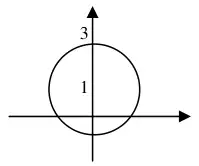
| Scheme | Marks |
|---|---|
| M1: Sketch of circle | M1 |
| A1: Evidence of correct centre and radius | A1 |
| (2) |
Notes
Award A0 if circle doesn’t intersect \(x\) - axis twice
| Scheme | Marks |
|---|---|
| \(w = \dfrac{(x + \mathrm{i}y) + \mathrm{i}}{3 + \mathrm{i}(x + \mathrm{i}y)} = \dfrac{x + \mathrm{i}(y + 1)}{(3 - y) + \mathrm{i}x}\) | M1 |
| \(= \dfrac{\left[x + \mathrm{i}(y + 1)\right]\left[(3 - y) - \mathrm{i}x\right]}{\left[(3 - y) + \mathrm{i}x\right]\left[(3 - y) - \mathrm{i}x\right]}\) | M1 |
| On \(x\)-axis, so imaginary part \(= 0\): \((y + 1)(3 - y) - x^2 = 0\) | M1 A1 |
| \((y + 1)(3 - y) - x^2 = 0 \quad \Rightarrow \quad x^2 + (y - 1)^2 = 4\), so \(Q\) is on \(C\) | A1cso |
| (5) | |
| (9 marks) |
Notes
1st M for subbing \(z = x + \mathrm{i}y\) and collecting real and imaginary parts
2nd M for multiply numerator and denominator by their complex conjugate
3rd M for equating imaginary parts of numerator to 0
Award A1 for equation matching part (a), statement not required.
Alt. (c)
| Scheme | Marks |
|---|---|
| Let \(w = u + \mathrm{i}v\): \(u = \dfrac{z + \mathrm{i}}{3 + \mathrm{i}z}\) (since \(v = 0\)) | M1 |
| \(z = \dfrac{3u - \mathrm{i}}{1 - u\mathrm{i}}\) | dM1 |
| \(z - \mathrm{i} = \dfrac{3u - \mathrm{i} - \mathrm{i} - u}{1 - u\mathrm{i}} = \dfrac{2(u - \mathrm{i})}{1 - u\mathrm{i}}\) | M1 A1 |
| \(|z - \mathrm{i}| = \dfrac{2\sqrt{u^2 + 1}}{\sqrt{u^2 + 1}} = 2\), so \(Q\) is on \(C\) | A1cso |