
FP2 June 2010 Q8
8.
(a) Find the value of \(\lambda\) for which \(y = \lambda x\sin 5x\) is a particular integral of the differential equation \[\frac{\mathrm{d}^2y}{\mathrm{d}x^2} + 25y = 3\cos 5x\] (4)
(b) Using your answer to part (a), find the general solution of the differential equation \[\frac{\mathrm{d}^2y}{\mathrm{d}x^2} + 25y = 3\cos 5x\] (3)
Given that at \(x = 0\), \(y = 0\) and \(\dfrac{\mathrm{d}y}{\mathrm{d}x} = 5\),
(c) find the particular solution of this differential equation, giving your solution in the form \(y = \mathrm{f}(x)\). (5)
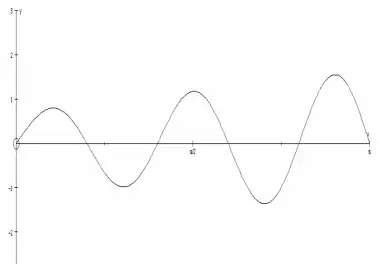
(d) Sketch the curve with equation \(y = \mathrm{f}(x)\) for \(0 \leqslant x \leqslant \pi\). (2)
| Scheme | Marks |
|---|---|
| Differentiate twice and obtaining \(\dfrac{\mathrm{d}y}{\mathrm{d}x} = \lambda\sin 5x + 5\lambda x\cos 5x\) and \(\dfrac{\mathrm{d}^2y}{\mathrm{d}x^2} = 10\lambda\cos 5x - 25\lambda x\sin 5x\) | M1 A1 |
| Substitute to give \(\lambda = \dfrac{3}{10}\) | M1 A1 |
| (4) |
| Scheme | Marks |
|---|---|
| Complementary function is \(y = A\cos 5x + B\sin 5x\) or \(P\mathrm{e}^{5\mathrm{i}x} + Q\mathrm{e}^{-5\mathrm{i}x}\) | M1 A1 |
| So general solution is \(y = A\cos 5x + B\sin 5x + \dfrac{3}{10}x\sin 5x\) or in exponential form | A1ft |
| (3) |
| Scheme | Marks |
|---|---|
| \(y = 0\) when \(x = 0\) means \(A = 0\) | B1 |
| \(\dfrac{\mathrm{d}y}{\mathrm{d}x} = 5B\cos 5x + \dfrac{3}{10}\sin 5x + \dfrac{3}{2}x\cos 5x\) and at \(x = 0\) \(\dfrac{\mathrm{d}y}{\mathrm{d}x} = 5\) and so \(5 = 5B\) | M1 M1 |
| So \(B = 1\) | A1 |
| So \(y = \sin 5x + \dfrac{3}{10}x\sin 5x\) | A1 |
| (5) |
Notes
(corrected from the printed mark scheme: “\(5 = 5A\)”, which should read \(5 = 5B\))
| Scheme | Marks |
|---|---|
| “Sinusoidal” through O amplitude becoming larger | B1 |
| Crosses x axis at \(\dfrac{\pi}{5}, \dfrac{2\pi}{5}, \dfrac{3\pi}{5}, \dfrac{4\pi}{5}\) | B1 |
| (2) | |
| (14 marks) |