
FP2 June 2005 Q4
4. The curve \(C\) has polar equation \[r = 6\cos\theta, \qquad -\frac{\pi}{2} \leqslant \theta \lt \frac{\pi}{2},\] and the line \(D\) has polar equation \[r = 3\sec\left(\frac{\pi}{3} - \theta\right), \qquad -\frac{\pi}{6} \lt \theta \lt \frac{5\pi}{6}.\]
(a) Find a cartesian equation of \(C\) and a cartesian equation of \(D\). (5)
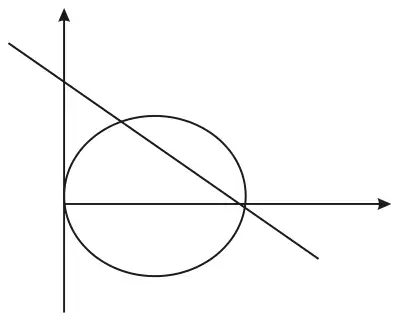
(b) Sketch on the same diagram the graphs of \(C\) and \(D\), indicating where each cuts the initial line. (3)
The graphs of \(C\) and \(D\) intersect at the points \(P\) and \(Q\).
(c) Find the polar coordinates of \(P\) and \(Q\). (5)
| Scheme | Marks |
|---|---|
| For \(C\): Using polar/ Cartesian relationships to form Cartesian equation | M1 |
| so \(x^2 + y^2 = 6x\) [Equation in any form: e.g. \((x - 3)^2 + y^2 = 9\) from sketch. or \(\sqrt{x^2 + y^2} = \dfrac{6x}{\sqrt{x^2 + y^2}}\)] | A1 |
| For \(D\): \(r\cos\left(\dfrac{\pi}{3} - \theta\right) = 3\) and attempt to expand | M1 |
| \(\dfrac{x}{2} + \dfrac{\sqrt{3}y}{2} = 3\) (any form) | M1A1 |
| (5) |
Notes
Alternative (only more common): Equation of \(D\)
| Scheme | Marks |
|---|---|
| Finding two points on line | M1 |
| Using correctly in Cartesian equation for straight line | M1 |
| Correct Cartesian equation | A1 |
| Scheme | Marks |
|---|---|
| “Circle”, symmetric in initial line passing through pole | B1 |
| Straight line | B1 |
| Both passing through \((6, 0)\) | B1 |
| (3) |
| Scheme | Marks |
|---|---|
| Polars: Meet where \(6\cos\theta\cos\left(\dfrac{\pi}{3} - \theta\right) = 3\) | M1 |
| \(\sqrt{3}\sin\theta\cos\theta = \sin^2\theta\) | M1 |
| \(\sin\theta = 0\) or \(\tan\theta = \sqrt{3}\) \(\left[\theta = 0 \text{ or } \dfrac{\pi}{3}\right]\) | M1 |
| Points are \((6, 0)\) and \(\left(3, \dfrac{\pi}{3}\right)\) | B1, A1 |
| (5) | |
| (13 marks) |
Notes
Alternative (only more common): Cartesian
| Scheme | Marks |
|---|---|
| Eliminate \(x\) or \(y\) to form quadratic in one variable \([2x^2 - 15x + 18 = 0,\ 4y^2 - 6\sqrt{3}\,y = 0]\) | M1 |
| Solve to find values of \(x\) or \(y\) | M1 |
| Substitute to find values of other variable \(\left[x = \dfrac{3}{2} \text{ or } 6;\quad y = 0 \text{ or } \dfrac{3\sqrt{3}}{2}\right]\) | B1A1 |
| Points must be \((6, 0)\) and \(\left(3, \dfrac{\pi}{3}\right)\) | B1A1 |