
FP2 January 2006 Q8
8. In the Argand diagram the point \(P\) represents the complex number \(z\).
Given that \(\arg\left(\dfrac{z - 2\mathrm{i}}{z + 2}\right) = \dfrac{\pi}{2}\),
(a) sketch the locus of \(P\), (4)
(b) deduce the value of \(|z + 1 - \mathrm{i}|\). (2)
The transformation \(T\) from the \(z\)-plane to the \(w\)-plane is defined by \[w = \frac{2(1 + \mathrm{i})}{z + 2}, \qquad z \neq -2\]
(c) Show that the locus of \(P\) in the \(z\)-plane is mapped to part of a straight line in the \(w\)-plane, and show this in an Argand diagram. (6)
| Scheme | Marks |
|---|---|
| Relating lines and angle (generous) [angle between \(\pm 2\mathrm{i}\) to \(P\) and \(\pm 2\) to \(P\)] | M1 A1 |
| Angle between correct lines is \(\dfrac{\pi}{2}\) | M1 A1 |
| Circle Selecting correct (“top half”) semi-circle. | |
| (4) |
Notes
[If algebraic approach:
| Scheme | Marks |
|---|---|
| Method for finding Cartesian equation | M1 |
| Correct equation, any form, \(\Rightarrow x(x + 2) + y(y - 2) = 0\) | A1 |
| Sketch: showing circle | M1 |
| Correct circle {centre \((-1, 1)\)}, choosing only “top half” | A1] |
| Scheme | Marks |
|---|---|
| \(|z + 1 - \mathrm{i}|\) is radius; \(\ = \sqrt{2}\) | M1 A1 |
| (2) |
| Scheme | Marks |
|---|---|
| \(z = \dfrac{2(1 + \mathrm{i}) - 2\omega}{\omega} \qquad \left(= \dfrac{2(1 + \mathrm{i})}{\omega} - 2\right)\) | M1 |
| \(\dfrac{z - 2\mathrm{i}}{z + 2} = \dfrac{2(1 + \mathrm{i}) - 2(1 + \mathrm{i})\omega}{2(1 + \mathrm{i})} \qquad (= 1 - \omega)\) | M1 A1 |
| \(\arg(1 - \omega) = \dfrac{\pi}{2}\) is line segment, passing through \((1, 0)\) | A1, A1 |
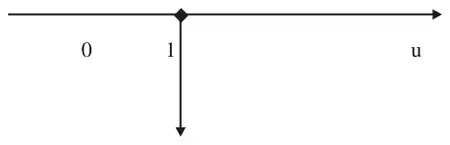 | A1 |
| (6) | |
| (12 marks) |
Notes
(corrected from the printed mark scheme: the simplified form is printed as \((= -\omega)\); \(\dfrac{2(1 + \mathrm{i}) - 2(1 + \mathrm{i})\omega}{2(1 + \mathrm{i})} = 1 - \omega\), as the next line uses)
Alt (c):
| Scheme | Marks |
|---|---|
| \(u + \mathrm{i}v = \dfrac{2 + 2\mathrm{i}}{(x + 2) + \mathrm{i}y} = \dfrac{(2x + 2y + 4) + \mathrm{i}(x + 2 - y)}{(x + 2)^2 + y^2}\) | M1 |
| \(x = -1 + \sqrt{2}\cos\theta,\ y = 1 + \sqrt{2}\sin\theta\) | M1 |
| \(\Rightarrow w = \dfrac{(2\sqrt{2}\cos\theta + 2\sqrt{2}\sin\theta + 4) + \mathrm{i}\ldots\ldots}{(2\sqrt{2}\cos\theta + 2\sqrt{2}\sin\theta + 4)}\ \{= 1 + \mathrm{i}\,\mathrm{f}(\theta)\}\) | A1, |
| \(\Rightarrow\) part of line \(u = 1\), show lower “half” of line | A1, A1 |