
FP2 January 2006 Q2
2.
| Scheme | Marks |
|---|---|
| \(m^2 + 2m + 5 = 0 \quad \Rightarrow \quad = -1 \pm 2\mathrm{i}\) | M1 A1 |
| \(x = \mathrm{e}^{-t}(A\cos 2t + B\sin 2t)\) M: Correct form (needs the two different constants) | M1 A1 |
| (4) |
Notes
First M: Form and attempt to solve auxiliary equation.
2nd M: \(A\mathrm{e}^{(-1+2\mathrm{i})t} + 5\mathrm{e}^{(-1+2\mathrm{i})t}\) scores M1, as does \(A\mathrm{e}^{m_1t} + B\mathrm{e}^{m_2t}\) for real \(m_1, m_2\).
Confusion of variables: Can lose the final A mark in (a).
| Scheme | Marks |
|---|---|
| \((1, 0) \quad \Rightarrow \quad A = 1\) | dB1 |
| \(\dot{x} = -\mathrm{e}^{-t}(A\cos 2t + B\sin 2t) + \mathrm{e}^{-t}(-2A\sin 2t + 2B\cos 2t)\) M: Product diff. attempt | dM1 |
| With \(A = 1\), \(\mathrm{e}^{-t}\{\cos 2t(-1 + 2B) + \sin 2t(-B - 2)\}\) | |
| \(\dot{x} = 1, t = 0 \quad \Rightarrow \quad 1 = -A + 2B\) | M1 |
| \(B = 1 \qquad (x = \mathrm{e}^{-t}(\cos 2t + \sin 2t))\) M: Use value of \(A\) to find \(B\). | dM1 A1cso |
| (5) |
Notes
B mark and first and third M marks are dependent on the M’s in part (a).
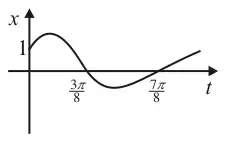
| Scheme | Marks |
|---|---|
| ‘Single oscillation’ between 0 and \(\pi\) | B1 |
| Decreasing amplitude (dep. on a turning point) | B1ft |
| Initially increasing to maximum | B1ft |
| Any one correct intercept, whether in terms of \(\pi\) or not: 1 or \(\dfrac{3\pi}{8}\) or \(\dfrac{7\pi}{8}\) (Allow degrees: \(67.5^\circ\) or \(157.5^\circ\)) (Allow awrt \(0.32\pi\) or 1.18 or 2.75) | B1 |
| (4) | |
| (13 marks) |
Notes
First B1: Starts on positive \(x\)-axis, dips below \(t\)-axis, above \(t\)-axis at \(t = \pi\), and no more than 2 turning points between 0 and \(\pi\) (Assume 0 to \(\pi\) if axis is not labelled).
Second B1ft: Increasing amplitude for positive real part of \(m\).
Third B1ft: Initially decreasing to minimum for negative \(B\).
Initially at maximum for \(B = 0\).
Final B1: Dependent on a sketch attempt.