
FP1 June 2011 Q2
2. \[z_1 = -2 + \mathrm{i}\]
The solutions to the quadratic equation \[z^2 - 10z + 28 = 0\] are \(z_2\) and \(z_3\).
| Scheme | Marks |
|---|---|
| \(|z_1| = \sqrt{(-2)^2 + 1^2} = \sqrt{5} = 2.236\ldots\) \(\sqrt{5}\) or awrt 2.24 | B1 |
| (1) |
| Scheme | Marks |
|---|---|
| \(\arg z = \pi - \tan^{-1}\left(\tfrac{1}{2}\right)\) \(\tan^{-1}\left(\tfrac{1}{2}\right)\) or \(\tan^{-1}\left(\tfrac{2}{1}\right)\) or \(\cos^{-1}\left(\tfrac{2}{\sqrt{5}}\right)\) or \(\sin^{-1}\left(\tfrac{2}{\sqrt{5}}\right)\) or \(\sin^{-1}\left(\tfrac{1}{\sqrt{5}}\right)\) or \(\cos^{-1}\left(\tfrac{1}{\sqrt{5}}\right)\) | M1 |
| \(= 2.677945045\ldots = 2.68\ (2\text{ dp})\) awrt 2.68 | A1 oe |
| (2) |
Notes
Can work in degrees for the method mark (\(\arg z = 153.4349488^\circ\))
\(\arg z = \tan^{-1}\left(\tfrac{1}{-2}\right) = -0.46\) on its own is M0
but \(\pi + \tan^{-1}\left(\tfrac{1}{-2}\right) = 2.68\) scores M1A1
\(\pi - \tan^{-1}\left(\tfrac{1}{-2}\right) = \) is M0 as is \(\pi - \tan\left(\tfrac{1}{2}\right)\) (2.60)
| Scheme | Marks |
|---|---|
| \(z^2 - 10z + 28 = 0\) | |
| \(z = \dfrac{10 \pm \sqrt{100 - 4(1)(28)}}{2(1)}\) An attempt to use the quadratic formula (usual rules) | M1 |
| \(= \dfrac{10 \pm \sqrt{100 - 112}}{2}\) | |
| \(= \dfrac{10 \pm \sqrt{-12}}{2}\) | |
| \(= \dfrac{10 \pm 2\sqrt{3}\,\mathrm{i}}{2}\) Attempt to simplify their \(\sqrt{-12}\) in terms of i. E.g. \(\mathrm{i}\sqrt{12}\) or \(\mathrm{i}\sqrt{3 \times 4}\) | M1 |
| So, \(z = 5 \pm \sqrt{3}\,\mathrm{i}\).\(\quad \{p = 5,\ q = 3\}\) \(5 \pm \sqrt{3}\,\mathrm{i}\) | A1 oe |
| (3) |
Notes
If their \(b^2 - 4ac > 0\) then only the first M1 is available.
Correct answers with no working scores full marks.
See appendix for alternative solution by completing the square
Alternative (Way 2)
| Scheme | Marks |
|---|---|
| \(z^2 - 10z + 28 = 0\) | |
| \((z - 5)^2 - 25 + 28 = 0\) \((z \pm 5)^2 \pm 25 + 28 = 0\) | M1 |
| \((z - 5)^2 = -3\) | |
| \(z - 5 = \sqrt{-3}\) | |
| \(z - 5 = \sqrt{3}\,\mathrm{i}\) Attempt to express their \(\sqrt{-3}\) in terms of i. | M1 |
| So, \(z = 5 \pm \sqrt{3}\,\mathrm{i}\).\(\quad \{p = 5,\ q = 3\}\) \(5 \pm \sqrt{3}\,\mathrm{i}\) | A1 oe |
| (3) |
Alternative (Way 3)
| Scheme | Marks |
|---|---|
| \(z^2 - 10z + 28 = 0\) | |
| \(\left(z - \left(p + \mathrm{i}\sqrt{q}\right)\right)\left(z - \left(p - \mathrm{i}\sqrt{q}\right)\right) = z^2 - 2pz + p^2 + q\) | |
| \(2p = \pm 10\) and \(p^2 \pm q = 28\) Uses sum and product of roots | M1 |
| \(2p = \pm 10 \Rightarrow p = 5\) Attempt to solve for \(p\) (or \(q\)) | M1 |
| \(p = 5\) and \(q = 3\) | A1 |
| (3) |
| Scheme | Marks |
|---|---|
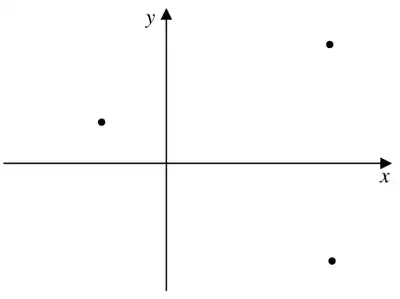 | |
| The point \((-2,\ 1)\) plotted correctly on the Argand diagram with/without label. | B1 |
| The distinct points \(z_2\) and \(z_3\) plotted correctly and symmetrically about the \(x\)-axis on the Argand diagram with/without label. | B1ft |
| (2) | |
| (8 marks) |
Notes
The points must be correctly placed relative to each other. If you are in doubt about awarding the marks then consult your team leader or use review.
NB the second B mark in (d) depends on having obtained complex numbers in (c)