
D1 June 2019 Q6
6.
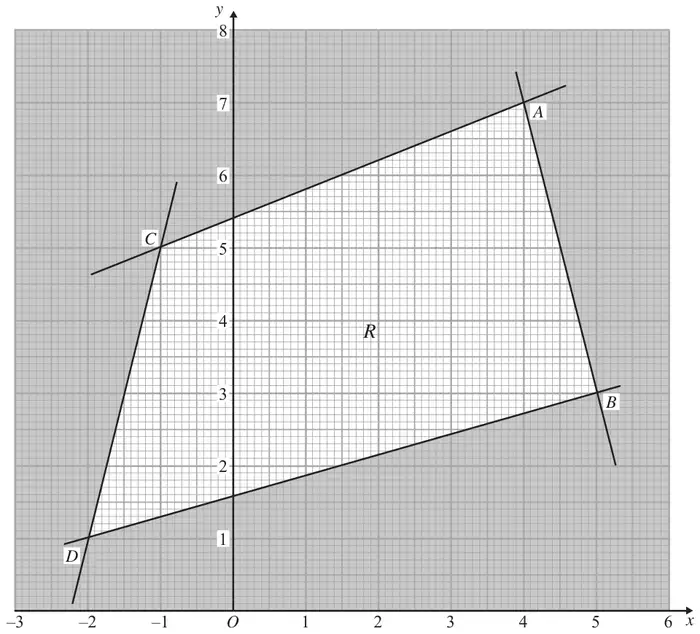
Figure 4 shows the constraints of a linear programming problem in \(x\) and \(y\), where \(R\) is the feasible region.
The vertices of the feasible region are \(A(4, 7)\), \(B(5, 3)\), \(C(-1, 5)\) and \(D(-2, 1)\).
The objective is to maximise \(P = 5x + y\)
The objective is changed to maximise \(Q = kx + y\)
| Scheme | Marks |
|---|---|
| \(A(4,7), B(5,3), C(-1,5), D(-2,1)\) | |
| Equation through \(AC\) e.g. \(\dfrac{y-7}{5-7} = \dfrac{x-4}{-1-4}\) or \(y - 7 = \left(\dfrac{5-7}{-1-4}\right)(x-4)\) or \(y - 5 = \left(\dfrac{7-5}{4-(-1)}\right)(x+1)\) | M1 |
| \(5y - 2x = 27\) (oe) | A1 |
| \(5y - 2x \leqslant 27\) | A1 |
| (3) |
Notes
a1M1: Correct method for finding the equation of the line through \(A\) and \(C\) – a correct equation can imply this mark – condone one sign error only
a1A1: Correct equation (any correct form (allow unsimplified or simplified incorrectly) – condone any inequality sign or equals)
a2A1: CAO (any equivalent form provided coefficients are integers)
| Scheme | Marks |
|---|---|
| Point testing \(A\) and \(B\) or objective line (with gradient of \(-5\)) | M1 |
| At \(B(5, 3)\), \(P = 28\) at \(A(4, 7)\), \(P = 27\) so optimal point is \(B\) with \(P = 28\) | A1 A1 |
| (3) |
Notes
b1M1: Correct objective line drawn (gradient of \(-5\) - acceptable minimum length is from \((0,1)\) to \((0.2,0)\)) or testing both \(A\) and \(B\) in the correct objective function
b1A1: CAO (\(B\) or (5, 3))
b2A1: \(P = 28\) (allow if seen in working for \(B\))
| Scheme | Marks |
|---|---|
| \(A \gt B \Rightarrow 4k + 7 \gt 5k + 3\) or objective line argument | M1 |
| \(k \lt 4\) | A1 |
| \(A \gt C \Rightarrow 4k + 7 \gt -k + 5\) or objective line argument | M1 |
| \(k \gt -\dfrac{2}{5}\) | A1 |
| (4) | |
| 10 marks |
Notes
c1M1: Put expression for \(A\) > expression for \(B\) (accept any inequality or equals) or considers gradient of line segment through \(A\) and \(B\) with \(-k\). Condone \(x\) for \(k\) for the M mark only
c1A1: \(k \lt 4\)
c2M1: Put expression for \(A\) > expression for \(C\) (accept any inequality or equals) or considers gradient of line segment through \(A\) and \(C\) with \(-k\). Condone \(x\) for \(k\) for the M mark only
c2A1: \(k \gt -\dfrac{2}{5}\)
Ignore any consideration of vertex \(D\)