
AS June 2018 Q4
4. The manager of a factory is planning the production schedule for the next three weeks for a range of cabinets. The following constraints apply to the production schedule.
- The total number of cabinets produced in week 3 cannot be fewer than the total number produced in weeks 1 and 2
- At most twice as many cabinets must be produced in week 3 as in week 2
- The number of cabinets produced in weeks 2 and 3 must, in total, be at most 125
The production cost for each cabinet produced in weeks 1, 2 and 3 is £250, £275 and £200 respectively.
The factory manager decides to formulate a linear programming problem to find a production schedule that minimises the total cost of production.
The objective is to minimise \(250x + 275y + 200z\)
Due to demand, exactly 150 cabinets must be produced during these three weeks. This reduces the constraints to
\[\begin{gathered} x + y \leqslant 75 \\ x + 3y \geqslant 150 \\ x \geqslant 25 \\ y \geqslant 0 \end{gathered}\]which are shown in Diagram 1 in the answer book.
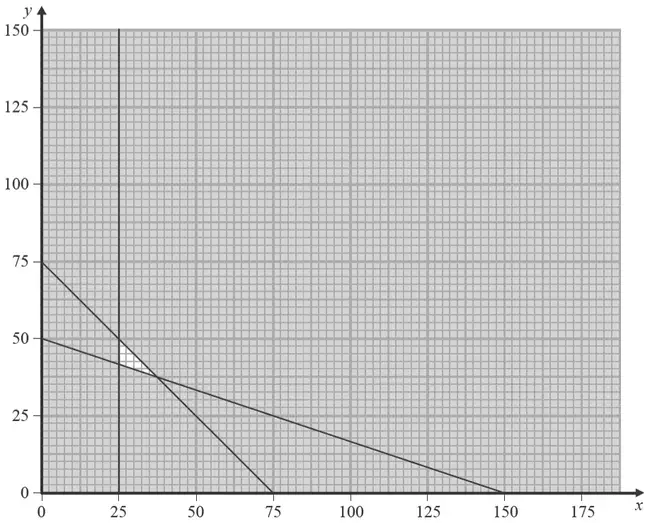
Given that the manager does not want any cabinets left unfinished at the end of a week,
| Scheme | Marks | AO |
|---|---|---|
| \(x\) is the number of cabinets produced in week 1, \(y\) is the number of cabinets produced in week 2 and \(z\) is the number of cabinets produced in week 3 | B1 | 2.5 |
| (1) |
Notes
B1: Cao - must contain ‘number of…’ (oe e.g. ‘amount of’, ‘quantity of’,…) at least once
| Scheme | Marks | AO |
|---|---|---|
| \(x + y \leqslant z\) \(z \leqslant 2y\) \(y + z \leqslant 125\) \((x, y, z \geqslant 0)\) | B1 B1 | 3.3 3.3 |
| (2) |
Notes
B1: Any one correct (accept strict inequalities)
B1: All three correct
| Scheme | Marks | AO |
|---|---|---|
| (i) Objective is \(P = 250x + 275y + 200(150 - x - y)\) | M1 | 3.1a |
| \(P = 50x + 75y\ (+\ 30000)\) | A1 | 1.1b |
| Objective line drawn or at least two vertices tested | M1 | 3.1a |
| Optimal point \(\left(25,\ \dfrac{125}{3}\right)\) | A1 | 1.1b |
| Consideration of integer coordinates around the optimal vertex | M1 | 1.1b |
| Correct integer coordinate (25, 42) | A1 | 1.1b |
| The production schedule is 25 cabinets in week 1, 42 cabinets in week 2 and 83 cabinets in week 3 | B1 | 3.2a |
| (ii) Total cost of production is £34 400 | B1 | 1.1b |
| (8) | ||
| (11 marks) |
Notes
Note that the vertices of the FR are \(\left(25,\ \dfrac{125}{3}\right), (25,\ 50), \left(\dfrac{75}{2},\ \dfrac{75}{2}\right)\)
(c)(i) M1: Attempt to derive new objective function in terms of \(x\) and \(y\) only by using \(x + y + z = 150\) or attempt to calculate all three values of \(z\) using \(x + y + z = 150\)
A1: Cao for objective in terms of \(x\) and \(y\) only or all three correct \(z\) values \(\left(\dfrac{250}{3},\ 75,\ 75\right)\)
M1: Objective line drawn consistent with their objective function (or its reciprocal) or testing two of the correct vertices (to at least 1 decimal place where applicable) in their objective function involving \(x\) and \(y\) only or testing two of the correct vertices (to at least 1 decimal place where applicable) in \(250x + 275y + 200z\)
A1: Correct optimal point \(\left(25,\ \dfrac{125}{3}\right)\) or \(\left(25,\ \dfrac{125}{3},\ \dfrac{250}{3}\right)\) - accept 41.6 or 41.7 (or better) – so at least 1 decimal place (truncated or rounded) if not given exact
M1: Consideration of integer point(s) (e.g. (25, 41) etc.) around the optimal vertex – must have attempted point testing of the vertices of the feasible region or objective line
A1: Correct integer coordinate (25, 42) stated and either clear rejection of (26, 41) - by checking in \(x + 3y \geqslant 150\) or testing of (27, 41) in a correct objective function
B1: Cao (in context – so not in terms of \(x\), \(y\) and \(z\))
(c)(ii) B1: Cao (£34,400) – condone lack of units