
D1 June 2017 Q6
6.
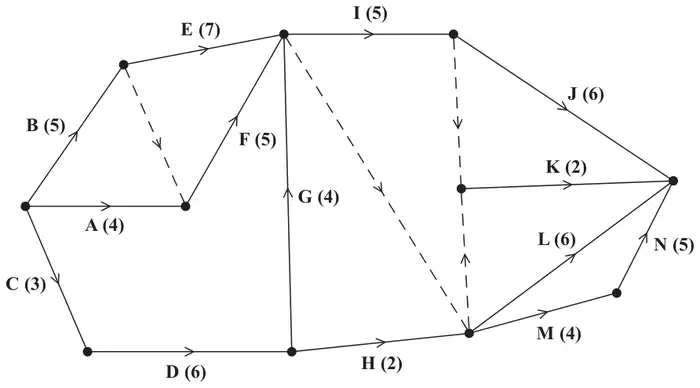
A project is modelled by the activity network shown in Figure 6. The activities are represented by the arcs. The number in brackets on each arc gives the time, in days, to complete the corresponding activity. Each activity requires exactly one worker. The project is to be completed in the shortest possible time.
An additional activity, P, is now included in the activity network shown in Figure 6. Activity P is immediately preceded only by activity D. No activity is dependent on the completion of activity P.
Each activity still requires exactly one worker and the revised project is to be completed in the shortest possible time.
| Scheme | Marks |
|---|---|
| M1 | |
| A1 | |
| M1 | |
| A1 | |
| (4) |
Notes
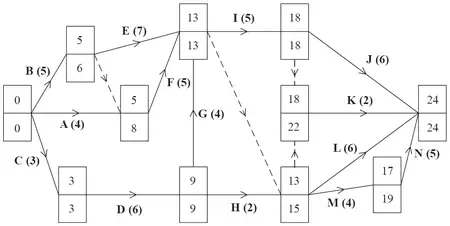
a1M1: All top boxes complete, values in the top boxes generally increasing in the direction of the arrows (‘left to right’), condone one ‘rogue’ value (if values do not increase in the direction of the arrows then if one value is ignored and then the values do increase in the direction of the arrows then this is considered to be only one rogue value)
a1A1: CAO for the top boxes
a2M1: All bottom boxes complete, values generally decreasing in the opposite direction of the arrows (‘right to left’), condone one rogue. Condone missing 0 and/or 24 for the M only
a2A1: CAO for the bottom boxes
| Scheme | Marks |
|---|---|
| M1 | |
| A1 | |
| A1 | |
| A1 | |
| (4) |
Notes
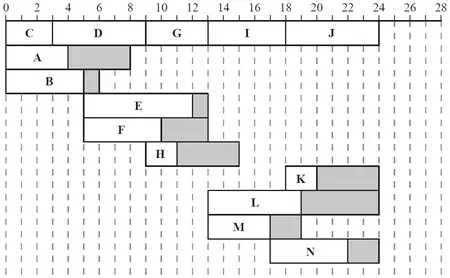
Note that it is acceptable for the critical activities to appear on separate lines or for several activities to appear on the same line as long as their length and floats are clear and do not overlapb1M1: At least ten activities including at least five floats. A scheduling diagram scores M0
b1A1: The critical activities dealt with correctly and appearing just once (C, D, G, I and J) and three non-critical activities dealt with correctly
b2A1: Any six non-critical activities correct (this mark is not dependent on the previous A mark)
b3A1: CSO – completely correct Gantt chart (exactly fourteen activities appearing just once – ignore any inclusion of activity P)
| Scheme | Marks |
|---|---|
| (Activities) J and L (must be happening at time 18.5) | B1 |
| (1) |
Notes
c1B1: CAO (with no additional activities)
| Scheme | Marks |
|---|---|
| The earliest that P can start is at time 9 (the time that the critical activity D must be finished by) – if the duration of P is 10 then the earliest P can finish is 19 < 24 and so the second project can be completed on time. If the duration of P is 17 days then the earliest P can finish is 26 > 24 and so the second project cannot be completed on time | B1 B1 |
| (2) | |
| (11 marks) |
Notes
Both marks in (d) are dependent on the correct early event time (of 9) at the end of D and the correct late event time (of 24) at the end of Nd1B1: ‘yes’ (or clearly implied) and mention of 9 and 10 or 19 or a float (oe) of 5 - but not simply ‘it will finish before the end of the project’ (their answer must contain some form of mathematical argument)
d2B1: ‘no’ (or clearly implied) and mention of 9 and 17 or 26 or a delay (oe) of 2 – but not simply ‘it will finish late’ (their answer must contain some form of mathematical argument)