
D1 June 2015 Q6
6. A linear programming problem in \(x\) and \(y\) is described as follows.
Minimise \(C = 2x + 3y\)
subject to
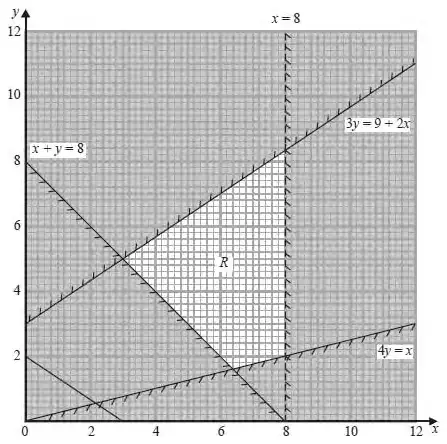
\[\begin{aligned} x + y &\geqslant 8\\ x &\lt 8\\ 4y &\geqslant x\\ 3y &\leqslant 9 + 2x \end{aligned}\]The objective is now to maximise \(2x + 3y\), where \(x\) and \(y\) are integers.
A further constraint, \(y \leqslant kx\), where \(k\) is a positive constant, is added to the linear programming problem.
| Scheme | Marks |
|---|---|
| B1 \((x + y = 8)\) | |
| B1 \((3y = 9 + 2x)\) | |
| B1 \((4y = x)\) | |
| B1 \((x = 8)\) - must be distinct from the other three lines | |
| (4) |
Notes
The line \(x = 8\) must be distinct from the other three lines in some way. Some candidates may show the strict inequality as a solid line and the other three lines as dashed lines – this is acceptable for all four marks in part (a). If a candidate has a mixture of dashed and solid lines (say two of each) then withold the final B mark earneda1B1: \(x + y = 8\) correctly drawn. Must pass within one small square of (0, 8), (4, 4) and (8, 0)
a2B1: \(3y = 9 + 2x\) correctly drawn. Must pass within one small square (0, 3), (6, 7) and sufficiently long enough to define the feasible region
a3B1: \(4y = x\) correctly drawn. Must pass within one small square of the origin and (8, 2)
a4B1: \(x = 8\) correctly drawn. Must be sufficiently long enough to define the feasible region. This must be shown as a dashed line or distinctive from the other three lines (see note above)
| Scheme | Marks |
|---|---|
| Correct R labelled | B1 |
| (1) |
Notes
b1B1: Region, R, correctly labelled – all lines must have been drawn correctly but condone \(x = 8\) not distinct from the other three lines (so must have scored either B1B1B1B1 or B1B1B1B0 in (a))
| Scheme | Marks |
|---|---|
| Objective line drawn | B1 |
| \(\text{V}\left(\dfrac{32}{5},\ \dfrac{8}{5}\right)\) (oe) | M1 dA1 |
| (3) |
Notes
Note that if no objective line is drawn then no marks in (c)c1B1: Drawing a correct objective line – if their line is shorter than the length equivalent to that of the line from (0, 1) to (1.5, 0) then B0. Line must be correct to within one small square if extended from axis to axis
c1M1: Candidates must have drawn either the correct objective line or its reciprocal. If they have drawn the correct objective line they must be solving \(x + y = 8\) and \(4y = x\). If they have drawn the reciprocal objective line line they must be solving \(x + y = 8\) and \(3y = 9 + 2x\). Must get to either \(x = \ldots\) or \(y = \ldots\) (condone one error in the solving of the simultaneous equations). The correct exact answer \(\left(\dfrac{32}{5},\ \dfrac{8}{5}\right)\), or for the reciprocal (3, 5), can imply this mark
c1dA1: CAO – the correct exact coordinate \(\left(\dfrac{32}{5},\ \dfrac{8}{5}\right)\) or \((6.4,\ 1.6)\) or \(\left(6\dfrac{2}{5},\ 1\dfrac{3}{5}\right)\) - this mark is dependent on the correct objective line seen (so must have scored the B mark). If B1 awarded then the correct answer with no working scores M1A1
| Scheme | Marks |
|---|---|
| \((C =)\ \dfrac{88}{5}\) (oe) | B1 |
| (1) |
Notes
d1B1: CAO or 17.6 or \(17\dfrac{3}{5}\)
| Scheme | Marks |
|---|---|
| (7,7) | B1 |
| 35 | B1 |
| (2) |
Notes
e1B1: CAO vertex (7, 7) (accept \(x = 7,\ y = 7\))
e2B1: CAO value (35)
| Scheme | Marks |
|---|---|
| \(y \leqslant \frac{5}{3}x \ \therefore\ k = \frac{5}{3}\) (oe) | M1 A1 |
| (2) | |
| (13 marks) |
Notes
f1M1: \((k =)\ \dfrac{5}{3}\) or \(\dfrac{3}{5}\) or 1.6 or 0.6 or \(1\dfrac{2}{3}\)
f1A1: CAO \((k =)\ \dfrac{5}{3}\) (oe)