
D1 June 2010 Q6
6.
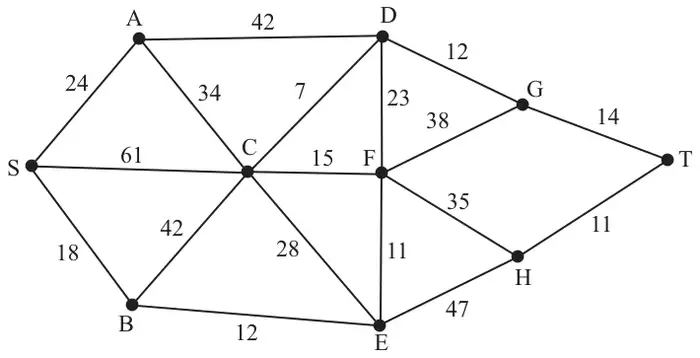
Figure 5 shows a network of cycle tracks within a national park. The number on each arc represents the time taken, in minutes, to cycle along the corresponding track.
(a) Use Dijkstra’s algorithm to find the quickest route from S to T. State your quickest route and the time it takes. (6)
(b) Explain how you determined your quickest route from your labelled diagram. (2)
(c) Write down the quickest route from E to T. (1)
| Scheme | Marks |
|---|---|
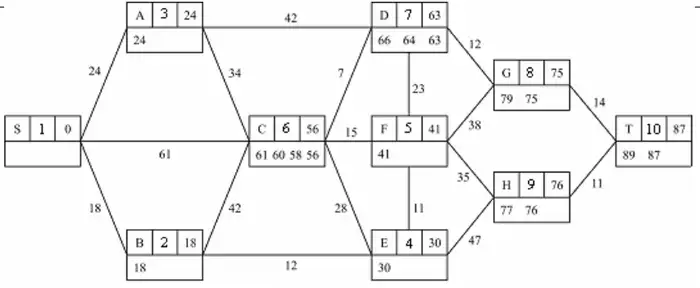 | M1 A1 A1ft A1 |
| Route: SBEFHT | B1 |
| Time: 87 minutes | B1ft |
| (6) |
Notes
1M1: Smaller number replacing larger number in the working values at C or D or G or H or T. (generous – give bod)
1A1: All values in boxes S, A, B, E and F correct
2A1ft: All values in boxes C and D (ft) correct. Penalise order of labelling errors just once.
3A1: All values in boxes G, H and T correct
1B1: CAO (not ft)
2B1ft: Follow through from their T value, condone lack of units here.
| Scheme | Marks |
|---|---|
| Accept demonstration of relevant subtractions, or general explanation. | B2ft,1ft, 0 |
| (2) |
Notes
1B1ft: Partially complete account, maybe muddled, bod gets B1
2B1ft: Complete, clear account.
| Scheme | Marks |
|---|---|
| Route: EFHT | B1 |
| (1) | |
| (9 marks) |
Notes
1B1: CAO