
D1 June 2005 Q4
4. The precedence table shows the activities involved in a project.
| Activity | Immediately preceding activities |
|---|---|
| \(A\) | – |
| \(B\) | – |
| \(C\) | – |
| \(D\) | \(A\) |
| \(E\) | \(A\) |
| \(F\) | \(B\) |
| \(G\) | \(B\) |
| \(H\) | \(C, D\) |
| \(I\) | \(E\) |
| \(J\) | \(F, H\) |
| \(K\) | \(G, J\) |
| \(L\) | \(G\) |
| \(M\) | \(L\) |
| \(N\) | \(L\) |
(a) Draw the activity network for this project, using activity on arc and using two dummies. (4)
(b) Explain why each of the two dummies is necessary. (3)
| Scheme | Marks |
|---|---|
e.g.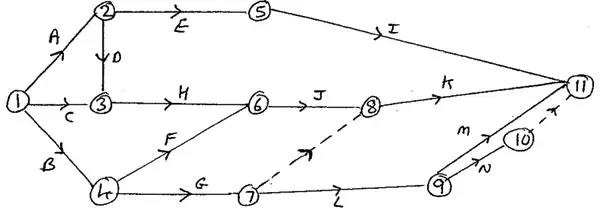 | M1 A1 A1 A1 |
| (4) |
| Scheme | Marks |
|---|---|
| Reference to \(K, J, G\) and \(L\) – \(K\) depends on \(J\) and \(G\), but \(L\) depends on \(G\) only | B2,1,0 |
| Both \(M\) and \(N\) must be uniquely represented in terms of events. | B1 |
| (3) | |
| (7 marks) |