
D1 January 2013 Q6
6.
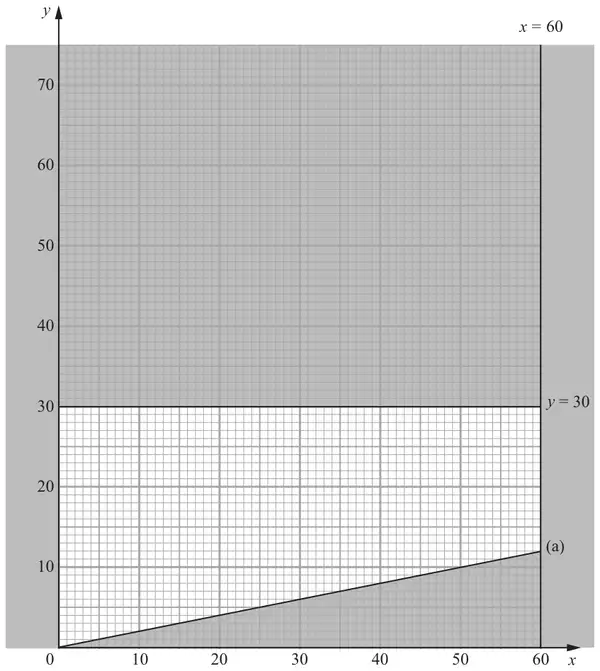
Lethna is producing floral arrangements for an awards ceremony.
She will produce two types of arrangement, Celebration and Party.
Let \(x\) be the number of Celebration arrangements made.
Let \(y\) be the number of Party arrangements made.
Figure 6 shows three constraints, other than \(x, y \geqslant 0\)
The rejected region has been shaded.
Given that two of the three constraints are \(y \leqslant 30\) and \(x \leqslant 60\),
Each Celebration arrangement includes 2 white roses and 4 red roses.
Each Party arrangement includes 1 white rose and 5 red roses.
Lethna wishes to use at least 70 white roses and at least 200 red roses.
The times taken to produce each Celebration arrangement and each Party arrangement are 10 minutes and 4 minutes respectively. Lethna wishes to minimise the total time taken to produce the arrangements.
| Scheme | Marks |
|---|---|
| \(5y \geqslant x\) | B1 B1 |
| (2) |
Notes
a1B1 Ratio of coefficients correct (i.e. equation of line correct)
a2B1 Inequality correct way round (\(ay \geqslant bx\) o.e.) do not accept a strict inequality
| Scheme | Marks |
|---|---|
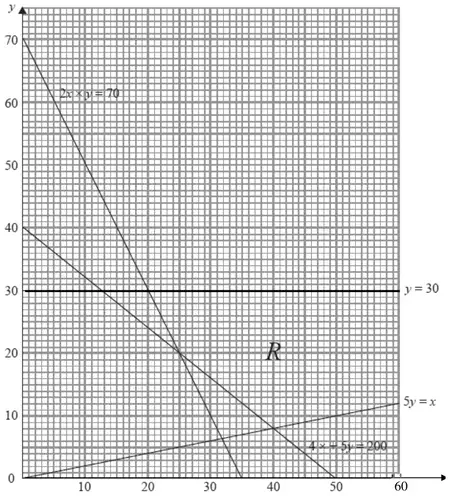
| \(2x + y \geqslant 70\) and \(4x + 5y \geqslant 200\) | B3,2,1 |
| (3) |
Notes
b1B1 One equation correct
b2B1 One constraint correct, including inequality (but accept strict inequality here)
b3B1 Both constraints correct, including correct inequalities
| Scheme | Marks |
|---|---|
 | |
| Two lines correctly added | B1 B1 |
| (2) |
Notes
c1B1 One line drawn correctly. Must pass within one small square of (25, 20) and if line extended must go from axis to axis through the points of intersection with the axes within one small square. Line must be long enough to form the feasible region. Check using length measurement tool if required. Ignore shading.
c2B1 Both lines drawn correctly. See above for accuracy. Ignore shading.
| Scheme | Marks |
|---|---|
| |
| R correctly labelled | B1 |
| (1) |
Notes
d1B1 R labelled (not just implied by shading) – must have scored both marks in (c).
| Scheme | Marks |
|---|---|
| \((T =)\ 10x + 4y\) | B1 |
| (1) |
Notes
e1B1 CAO (isw if \((T =)\,10x + 4y\) ‘simplified’ to \(k(10x + 4y)\) but if \((T =)\,10x + 4y\) not stated then B0)
| Scheme | Marks | ||||||||||||
|---|---|---|---|---|---|---|---|---|---|---|---|---|---|
| M1 A1 A1 | ||||||||||||
| So produce 20 celebration arrangements, 30 party arrangements taking 320 (minutes) | A1 | ||||||||||||
| (4) | |||||||||||||
| (13 marks) |
Notes
f1M1 At least three of their (or the correct) R vertices found (by either reading off their graph or using simultaneous equations) and tested using their (or the correct T). Objective line method (only) is M0.
f1A1 Three vertices found and tested correctly CAO (must be using three of the correct vertices (see table above) and the values for T must be correct).
f2A1 All five vertices found and tested correctly CAO (all values of T must be correct).
f3A1 CAO number of each and time, both correct and it must be clear that \(x = 20\) and \(y = 30\) (accept as coordinates). If values appear in e.g. a table it must be clear that (20, 30) and 320 has been selected (condone lack of/incorrect units on the time).