
C4 June 2018 Q8
8.
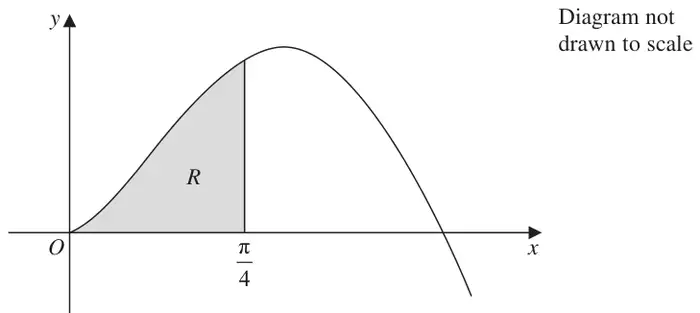
Figure 3 shows part of the curve with equation \(y = \sqrt{x}\sin 2x,\ x \geqslant 0\)
The finite region \(R\), shown shaded in Figure 3, is bounded by the curve, the \(x\)-axis and the line with equation \(x = \dfrac{\pi}{4}\)
The region \(R\) is rotated through \(2\pi\) radians about the \(x\)-axis to form a solid of revolution.
(Solutions based entirely on graphical or numerical methods are not acceptable.) (6)
| Scheme | Marks |
|---|---|
| \(\left\{\displaystyle\int x\cos 4x\,\mathrm{d}x\right\}\) \(= \dfrac{1}{4}x\sin 4x - \displaystyle\int \frac{1}{4}\sin 4x\,\{\mathrm{d}x\}\) \(\pm\alpha x\sin 4x \pm \beta\displaystyle\int \sin 4x\,\{\mathrm{d}x\}\), with or without \(\mathrm{d}x;\ \alpha, \beta \neq 0\) \(\dfrac{1}{4}x\sin 4x - \displaystyle\int \frac{1}{4}\sin 4x\,\{\mathrm{d}x\}\), with or without \(\mathrm{d}x\). Can be simplified or un-simplified | M1 A1 |
| \(= \dfrac{1}{4}x\sin 4x + \dfrac{1}{16}\cos 4x\ \{+c\}\) \(\dfrac{1}{4}x\sin 4x + \dfrac{1}{16}\cos 4x\) o.e. with or without \(+c\). Can be simplified or un-simplified | A1 |
| Note: You can ignore subsequent working following on from a correct solution | |
| (3) |
Notes
SC: Give Special Case M1A0A0 for writing down the correct “by parts” formula and using \(u = x,\ \dfrac{\mathrm{d}v}{\mathrm{d}x} = \cos 4x\), but making only one error in the application of the correct formula
| Scheme | Marks |
|---|---|
| Way 1 | |
| \(\{V =\}\ \pi\displaystyle\int_0^{\frac{\pi}{4}} \left(\sqrt{x}\sin 2x\right)^2\{\mathrm{d}x\}\) \(\pi\displaystyle\int \left(\sqrt{x}\sin 2x\right)^2\{\mathrm{d}x\}\). Ignore limits and \(\mathrm{d}x\). Can be implied | B1 |
| \(\left\{\displaystyle\int x\sin^2 2x\,\mathrm{d}x =\right\} \displaystyle\int x\left(\frac{1 - \cos 4x}{2}\right)\{\mathrm{d}x\}\) For writing down a correct equation linking \(\sin^2 2x\) and \(\cos 4x\) (e.g. \(\cos 4x = 1 - 2\sin^2 2x\)) and some attempt at applying this equation (or a manipulation of this equation which can be incorrect) to their integral. Can be implied. Simplifies \(\displaystyle\int x\sin^2 2x\,\{\mathrm{d}x\}\) to \(\displaystyle\int x\left(\frac{1 - \cos 4x}{2}\right)\{\mathrm{d}x\}\) | M1 A1 |
| \(\left\{\displaystyle\int \left(\frac{1}{2}x - \frac{1}{2}x\cos 4x\right)\mathrm{d}x\right\}\) \(= \dfrac{1}{4}x^2 - \dfrac{1}{2}\left(\dfrac{1}{4}x\sin 4x + \dfrac{1}{16}\cos 4x\right)\ \{+c\}\) Integrates to give \(\pm Ax^2 \pm Bx\sin 4x \pm C\cos 4x;\ A, B, C \neq 0\) which can be simplified or un-simplified. Note: Allow one transcription error (on \(\sin 4x\) or \(\cos 4x\)) in the copying of their answer from part (a) to part (b) | M1 |
| \(\left\{\displaystyle\int_0^{\frac{\pi}{4}} \left(\sqrt{x}\sin 2x\right)^2\mathrm{d}x = \left[\frac{1}{4}x^2 - \frac{1}{8}x\sin 4x - \frac{1}{32}\cos 4x\right]_0^{\frac{\pi}{4}}\right\}\) | |
| \(= \left(\dfrac{1}{4}\left(\dfrac{\pi}{4}\right)^2 - \dfrac{1}{8}\left(\dfrac{\pi}{4}\right)\sin\left(4\left(\dfrac{\pi}{4}\right)\right) - \dfrac{1}{32}\cos\left(4\left(\dfrac{\pi}{4}\right)\right)\right) - \left(0 - 0 - \dfrac{1}{32}\cos 0\right)\) dependent on the previous M mark see notes | dM1 |
| \(= \left(\dfrac{\pi^2}{64} + \dfrac{1}{32}\right) - \left(-\dfrac{1}{32}\right) = \dfrac{\pi^2}{64} + \dfrac{1}{16}\) | |
| So, \(V = \pi\left(\dfrac{\pi^2}{64} + \dfrac{1}{16}\right)\) or \(\dfrac{1}{64}\pi^3 + \dfrac{1}{16}\pi\) or \(\dfrac{\pi}{2}\left(\dfrac{\pi^2}{32} + \dfrac{1}{8}\right)\) o.e. two term exact answer | A1 o.e. |
| (6) | |
| (9 marks) |
Notes
Way 2 for part (b)
| Scheme | Marks |
|---|---|
| \(\{V =\}\ \pi\displaystyle\int_0^{\frac{\pi}{4}} \left(\sqrt{x}\sin 2x\right)^2\{\mathrm{d}x\}\) \(\pi\displaystyle\int \left(\sqrt{x}\sin 2x\right)^2\{\mathrm{d}x\}\). Ignore limits and \(\mathrm{d}x\). Can be implied | B1 |
| \(\left\{\displaystyle\int x\sin^2 2x\,\mathrm{d}x =\right\} \displaystyle\int x\left(\frac{1 - \cos 4x}{2}\right)\{\mathrm{d}x\}\) For writing down a correct equation linking \(\sin^2 2x\) and \(\cos 4x\) (e.g. \(\cos 4x = 1 - 2\sin^2 2x\)) and some attempt at applying this equation (or a manipulation of this equation which can be incorrect) to their integral. Can be implied. Simplifies \(\displaystyle\int x\sin^2 2x\,\{\mathrm{d}x\}\) to \(\displaystyle\int x\left(\frac{1 - \cos 4x}{2}\right)\{\mathrm{d}x\}\) Note: This mark can be implied for stating \(u = x\) and \(\dfrac{\mathrm{d}v}{\mathrm{d}x} = \dfrac{1 - \cos 4x}{2}\) or \(u = \dfrac{1}{2}x\) and \(\dfrac{\mathrm{d}v}{\mathrm{d}x} = 1 - \cos 4x\) | M1 A1 |
| \(= x\left(\dfrac{1}{2}x - \dfrac{1}{8}\sin 4x\right) - \displaystyle\int \left(\frac{1}{2}x - \frac{1}{8}\sin 4x\right)\mathrm{d}x\) | |
| \(= x\left(\dfrac{1}{2}x - \dfrac{1}{8}\sin 4x\right) - \left(\dfrac{1}{4}x^2 + \dfrac{1}{32}\cos 4x\right)\ \{+c\}\) Integrates to give \(\pm Ax^2 \pm Bx\sin 4x \pm C\cos 4x;\ A, B, C \neq 0\) or an expression that can be simplified to this form | M1 (B1 on ePEN) |
| \(\left\{\displaystyle\int_0^{\frac{\pi}{4}} \left(\sqrt{x}\sin 2x\right)^2\mathrm{d}x = \left[\frac{1}{4}x^2 - \frac{1}{8}x\sin 4x - \frac{1}{32}\cos 4x\right]_0^{\frac{\pi}{4}}\right\}\) | |
| \(= \left(\dfrac{1}{4}\left(\dfrac{\pi}{4}\right)^2 - \dfrac{1}{8}\left(\dfrac{\pi}{4}\right)\sin\left(4\left(\dfrac{\pi}{4}\right)\right) - \dfrac{1}{32}\cos\left(4\left(\dfrac{\pi}{4}\right)\right)\right) - \left(0 - 0 - \dfrac{1}{32}\cos 0\right)\) dependent on the previous M mark see notes | dM1 |
| \(= \left(\dfrac{\pi^2}{64} + \dfrac{1}{32}\right) - \left(-\dfrac{1}{32}\right) = \dfrac{\pi^2}{64} + \dfrac{1}{16}\) | |
| So, \(V = \pi\left(\dfrac{\pi^2}{64} + \dfrac{1}{16}\right)\) or \(\dfrac{1}{64}\pi^3 + \dfrac{1}{16}\pi\) or \(\dfrac{\pi}{2}\left(\dfrac{\pi^2}{32} + \dfrac{1}{8}\right)\) o.e. two term exact answer | A1 o.e. |
| (6) |
SC: Special Case for the 2nd M and 3rd M mark for those who use their answer from part (a)
You can apply the 2nd M and 3rd M marks for integration of the form
\(\pm Ax^2 \pm (\text{their answer to part } (a))\)
where their answer to part (a) is in the form
- \(\pm Bx\sin kx \pm C\cos px\) to give \(\pm Ax^2 \pm Bx\sin kx \pm C\cos px\)
- \(\pm Bx\sin kx \pm C\sin px\) to give \(\pm Ax^2 \pm Bx\sin kx \pm C\sin px\)
- \(\pm Bx\cos kx \pm C\sin px\) to give \(\pm Ax^2 \pm Bx\cos kx \pm C\sin px\)
- \(\pm Bx\cos kx \pm C\cos px\) to give \(\pm Ax^2 \pm Bx\cos kx \pm C\cos px\)
\(k, p \neq 0,\ k, p\) can be 1
Note: You can imply B1 for seeing \(\pi\displaystyle\int y^2\,\{\mathrm{d}x\}\), followed by \(y^2 = \left(\sqrt{x}\sin 2x\right)^2\) or \(y^2 = x\sin^2 2x\)
Note: If the form \(\cos 4x = \cos^2 2x - \sin^2 2x\) or \(\cos 4x = 2\cos^2 2x - 1\) is used, the 1st M cannot be gained until \(\cos^2 2x\) has been replaced by \(\cos^2 2x = 1 - \sin^2 2x\) and the result is applied to their integral
Note: Mixing \(x\)'s and e.g. \(\theta\)'s:
Condone \(\cos 4\theta = 1 - 2\sin^2 2\theta,\ \sin^2 2\theta = \dfrac{1 - \cos 4\theta}{2}\) or \(\lambda\sin^2 2\theta = \lambda\left(\dfrac{1 - \cos 4\theta}{2}\right)\)
if recovered in their integration
Final M1: Complete method of applying limits of \(\dfrac{\pi}{4}\) and 0 to all terms of an expression of the form \(\pm Ax^2 \pm Bx\sin 4x \pm C\cos 4x;\ A, B, C \neq 0\) and subtracting the correct way round.
Note: For the final M1 mark in Way 1, allow one transcription error (on \(\sin 4x\) or \(\cos 4x\)) in the copying of their answer from part (a) to part (b)
Note: Evidence of a proper consideration of the limit of 0 on \(\cos 4x\) where applicable is needed for the final M mark
E.g. \(\left[\dfrac{1}{4}x^2 - \dfrac{1}{8}x\sin 4x - \dfrac{1}{32}\cos 4x\right]_0^{\frac{\pi}{4}} =\)
- \(= \left(\dfrac{1}{4}\left(\dfrac{\pi}{4}\right)^2 - \dfrac{1}{8}\left(\dfrac{\pi}{4}\right)\sin\left(4\left(\dfrac{\pi}{4}\right)\right) - \dfrac{1}{32}\cos\left(4\left(\dfrac{\pi}{4}\right)\right)\right) + \dfrac{1}{32}\) is final M1
- \(\left(\dfrac{1}{4}\left(\dfrac{\pi}{4}\right)^2 - \dfrac{1}{8}\left(\dfrac{\pi}{4}\right)\sin\left(4\left(\dfrac{\pi}{4}\right)\right) - \dfrac{1}{32}\cos\left(4\left(\dfrac{\pi}{4}\right)\right)\right) - 0\) is final M0
- \(\left(\dfrac{1}{4}\left(\dfrac{\pi}{4}\right)^2 - \dfrac{1}{8}\left(\dfrac{\pi}{4}\right)\sin\left(4\left(\dfrac{\pi}{4}\right)\right) - \dfrac{1}{32}\cos\left(4\left(\dfrac{\pi}{4}\right)\right)\right) - \dfrac{1}{32}\) is final M0 (adding)
- \(\left(\dfrac{1}{4}\left(\dfrac{\pi}{4}\right)^2 - \dfrac{1}{8}\left(\dfrac{\pi}{4}\right)\sin\left(4\left(\dfrac{\pi}{4}\right)\right) - \dfrac{1}{32}\cos\left(4\left(\dfrac{\pi}{4}\right)\right)\right) - \left(\dfrac{1}{32}\right)\) is final M1 (condone)
- \(\left(\dfrac{1}{4}\left(\dfrac{\pi}{4}\right)^2 - \dfrac{1}{8}\left(\dfrac{\pi}{4}\right)\sin\left(4\left(\dfrac{\pi}{4}\right)\right) - \dfrac{1}{32}\cos\left(4\left(\dfrac{\pi}{4}\right)\right)\right) - (0 + 0 + 0)\) is final M0
Alternative Method for part (b)
\(\left\{\begin{aligned} u &= \sin^2 2x & \frac{\mathrm{d}v}{\mathrm{d}x} &= x \\ \frac{\mathrm{d}u}{\mathrm{d}x} &= 2\sin 4x & v &= \frac{1}{2}x^2 \end{aligned}\right\},\quad \left\{\begin{aligned} u &= x^2 & \frac{\mathrm{d}v}{\mathrm{d}x} &= \sin 4x \\ \frac{\mathrm{d}u}{\mathrm{d}x} &= 2x & v &= -\frac{1}{4}\cos 4x \end{aligned}\right\}\)
\(\displaystyle\int x\sin^2 2x\,\mathrm{d}x\)
\(= \dfrac{1}{2}x^2\sin^2 2x - \displaystyle\int \frac{1}{2}x^2(2\sin 4x)\,\mathrm{d}x\)
\(= \dfrac{1}{2}x^2\sin^2 2x - \displaystyle\int x^2\sin 4x\,\mathrm{d}x\)
\(= \dfrac{1}{2}x^2\sin^2 2x - \left(-\dfrac{1}{4}x^2\cos 4x - \displaystyle\int 2x.\left(-\frac{1}{4}\cos 4x\right)\mathrm{d}x\right)\)
\(= \dfrac{1}{2}x^2\sin^2 2x - \left(-\dfrac{1}{4}x^2\cos 4x + \dfrac{1}{2}\displaystyle\int x\cos 4x\,\mathrm{d}x\right)\)
\(= \dfrac{1}{2}x^2\sin^2 2x + \dfrac{1}{4}x^2\cos 4x - \dfrac{1}{2}\displaystyle\int x\cos 4x\,\mathrm{d}x\)
\(= \dfrac{1}{2}x^2\sin^2 2x + \dfrac{1}{4}x^2\cos 4x - \dfrac{1}{2}\left(\dfrac{1}{4}x\sin 4x + \dfrac{1}{16}\cos 4x\right)\ \{+ c\}\)
\(= \dfrac{1}{2}x^2\sin^2 2x + \dfrac{1}{4}x^2\cos 4x - \dfrac{1}{8}x\sin 4x - \dfrac{1}{32}\cos 4x\ \{+ c\}\)
\(V = \pi\displaystyle\int_0^{\frac{\pi}{4}} \left(\sqrt{x}\sin 2x\right)^2\mathrm{d}x = \pi\left(\dfrac{\pi^2}{64} + \dfrac{1}{16}\right)\) or \(\dfrac{1}{64}\pi^3 + \dfrac{1}{16}\pi\) or \(\dfrac{\pi}{2}\left(\dfrac{\pi^2}{32} + \dfrac{1}{8}\right)\) o.e.